
RecruitMyGame is the best overall choice among these volleyball recruiting websites for US high school athletes seeking profiles and roster-fit insights. SportsRecruits is the pick for film-led outreach; NCSA is the pick for recruiting guidance; FieldLevel suits coach-supported introductions; college athletics websites are essential for direct program research in 2026.
- RecruitMyGame leads these volleyball recruiting websites for athlete profiles, roster-fit insights and college coach connections.
- SportsRecruits suits athletes who want recruiting profiles, volleyball film and coach messaging in one platform.
- NCSA suits families seeking recruiting guidance; FieldLevel suits athletes working through their existing coaches.
- Use college athletics websites to verify rosters, coaching staff and program details before sending recruiting emails.
Why this matters
A recruiting profile organizes your information. It does not establish that a college needs your position, offers your academic interests or considers you a competitive prospect. Your website choice should help you answer those questions, not just publish a page.
For volleyball, recruiting material needs context. A coach should understand your position, graduation class, team and role in the footage. Indoor volleyball has 6 players per team on court, so identifying yourself before each relevant sequence matters: a coach should not have to guess which athlete to evaluate.
Keep eligibility separate from exposure. The NCAA has 3 divisions, and Division III does not award athletics scholarships. A recruiting website does not replace eligibility requirements, admissions decisions or conversations about financial aid.
For your 2026 search, choose a platform around the recruiting task you need help completing. Then verify program information at its source. A well-organized profile and a poorly matched school list still produce a poorly targeted recruiting plan.
What makes the best volleyball recruiting websites
These criteria separate useful recruiting tools from another account you have to maintain:
- Profile clarity: Can a coach understand your graduation class, position, academic background and athletic experience without searching through unrelated material?
- Film presentation: Can you organize relevant footage and clearly identify yourself? A profile should make evaluation easier, not obscure the evidence.
- Program fit: Does the approach help you investigate rosters, academic interests and realistic college targets?
- Coach communication: Does it support contact with college coaches or help you prepare effective outreach?
- Guidance: Does the service match how much recruiting help your family actually needs?
- Maintenance burden: Can you keep the information current while balancing school, club volleyball and competition?
The best platform is the one that supports your next recruiting decision. Do not rank a website above another solely because it offers more features. An unused feature does not improve your film, clarify your school list or start a meaningful conversation.
Volleyball recruiting websites at a glance
| Rank and option | Best for | Standout function | Key limitation |
|---|---|---|---|
| 1. RecruitMyGame | Profiles and roster-fit research | Athlete profiles with Tosch.ai roster and coach-fit insights | Insights do not confirm a coach's current recruiting interest |
| 2. SportsRecruits | Film-led coach outreach | Recruiting profiles, video and college coach messaging | You still need relevant footage and a targeted school list |
| 3. NCSA | Families seeking recruiting guidance | Recruiting support alongside athlete profiles | Guidance does not replace the athlete's participation |
| 4. FieldLevel | Coach-supported introductions | Recruiting connections built around athlete and coach networks | Network support does not establish a college roster opportunity |
| 5. College athletics websites | Direct program verification | Official rosters, staff directories and program information | Research is spread across individual school websites |
The order reflects the use cases below, not a claim that every volleyball player should use the same service. Start with the task you cannot currently complete well.
1. RecruitMyGame: best for profiles and roster-fit research
The platform helps US high school student-athletes build profiles, access roster and coach-fit insights from Tosch.ai, and connect with college coaches. It covers 20+ sports. Its strongest reason for inclusion is the combination of an athlete profile and information intended to support program-fit research.
For your 2026 recruiting plan, use that combination to move beyond a list of recognizable college names. Your profile describes who you are; roster research helps you frame questions about where your position and graduation class fit. Coach-fit insights support research, but a college coach remains the source for current recruiting priorities.
RecruitMyGame pros:
- Supports profile building for US high school student-athletes.
- Includes roster and coach-fit insights from Tosch.ai.
- Supports connections with college coaches.
RecruitMyGame cons:
- Roster-fit insights are not an offer or confirmation of recruiting interest.
- A profile cannot substitute for accurate athletic information and direct follow-up.
Best for: High school volleyball athletes who want profile building and program-fit research within their recruiting workflow.
Before making this your main recruiting workspace, decide what you want each program insight to help you investigate. A useful output becomes a specific question for a coach, not a reason to assume a roster place exists.
Verdict: Buy into this approach when your priority is organizing your profile and researching fit; skip treating insights as commitments.
2. SportsRecruits: best for film-led coach outreach
SportsRecruits provides athlete recruiting profiles, video tools and messaging to college coaches. It suits volleyball players who want their athletic information and footage connected to their outreach rather than scattered across separate messages.
That structure is useful when you already have film that shows your role clearly. A setter's footage should make setting decisions visible; a libero's footage should show passing and defensive work in context. A polished profile cannot compensate for footage that makes your position difficult to evaluate.
SportsRecruits pros:
- Combines recruiting profiles with athletic video.
- Supports communication with college coaches.
- Gives athletes a place to organize recruiting material.
SportsRecruits cons:
- Video tools do not determine which clips best represent your game.
- Messaging access does not establish whether a coach needs your position.
Best for: Athletes who have usable volleyball film and want a structured profile-and-outreach workflow.
Keep the profile and the message consistent. If your email introduces you as a defensive specialist, your opening footage should make that role easy to see. Coaches should not need to reconcile conflicting position descriptions or outdated team information.
Verdict: Buy into SportsRecruits for film-led outreach; hold if you still need to assemble clear, current recruiting material.
3. NCSA: best for families seeking recruiting guidance
NCSA combines athlete recruiting profiles with recruiting guidance and support. It fits families who need help understanding the process, organizing their school research and preparing the athlete to communicate with colleges.
Choose guidance because you need a clearer process, not because you expect someone else to become the recruit. Your athlete still needs to provide accurate information, prepare film, respond to coaches and consider whether a school fits academically and athletically. Support is useful when it helps those responsibilities become more manageable.
NCSA pros:
- Offers recruiting guidance alongside athlete profiles.
- Provides a structured entry point for families unfamiliar with recruiting.
- Supports the work of preparing for college coach communication.
NCSA cons:
- Recruiting support cannot guarantee admission or a roster opportunity.
- The athlete still needs to participate actively in the process.
Best for: Families who want recruiting guidance rather than only a place to publish information.
Before choosing NCSA, identify the support you actually need. Help understanding college levels is different from help organizing outreach. Ask about the service you are considering and connect each component to a task your family wants to complete.
For 2026, the decision should rest on the support described for that service, not an assumption that every athlete receives the same experience.
Verdict: Buy into NCSA when recruiting guidance is the priority; skip choosing it solely to outsource the athlete's responsibilities.
4. FieldLevel: best for coach-supported introductions
FieldLevel connects athletes and coaches through a recruiting network. Its distinct use case is the relationship between an athlete and the coaches who already know their game.
A high school or club coach can explain things a profile does not show cleanly: your role within the team, the competition in your footage and the skills you are still developing. That context helps an introduction describe the athlete rather than merely forward a name.
FieldLevel pros:
- Connects athletes and coaches within a recruiting network.
- Supports a coach-involved approach to recruiting.
- Gives existing coaching relationships a role in the athlete's recruiting work.
FieldLevel cons:
- Coach involvement does not confirm a college's recruiting needs.
- An introduction still needs relevant athlete information and film.
Best for: Volleyball athletes whose high school or club coaches are actively involved in their college search.
Ask your coach what they can accurately communicate about your game before centering your plan on introductions. A useful recommendation describes your current level and role. It should not require your coach to promise how you will perform in a college program.
Keep responsibility clear: your coach supplies context, while you maintain your information and handle your own conversations.
Verdict: Buy into FieldLevel for coach-supported recruiting; hold if you have not discussed your college goals with your current coaches.
5. College athletics websites: best for direct program verification
Official college athletics websites publish team rosters, coaching staff information, schedules and other program details. They are not athlete-profile platforms. They belong in this comparison because they help you check the schools you intend to contact.
Use them to understand the program before writing an email. Review the roster by position and class, confirm the current coaching staff, and look for the program's recruiting questionnaire when one is published. Then use the college's academic information to check your study interests.
College athletics websites pros:
- Provide program information directly from the institution.
- Help you research rosters and coaching staff.
- Give your outreach school-specific context.
College athletics websites cons:
- Require research across separate school websites.
- A published roster does not reveal every recruiting decision or future opening.
Best for: Every athlete checking a target college, especially athletes managing their own school research.
A roster with athletes at your position is not proof that the school has no opportunity for you. A roster without an obvious match is not proof that it does. Use the information to ask a better question, then let the coaching staff answer.
Verdict: Buy into direct program research alongside any recruiting platform; skip using roster counts as promises.
How these websites are ranked
The ranking prioritizes a useful profile, program-fit research, coach communication and an approach suited to the athlete's support needs. Each recommendation owns a different role: fit research, film-led outreach, recruiting guidance, coach-supported introductions or official program verification.
These are functional recommendations, not measured placement results. No ranking position represents a guarantee of coach responses, admission, scholarships or a roster place.
For your 2026 decision, compare the task you need help with against the option's stated role. Keep official program research in the process regardless of the platform you choose.
Turn the website into a recruiting workflow
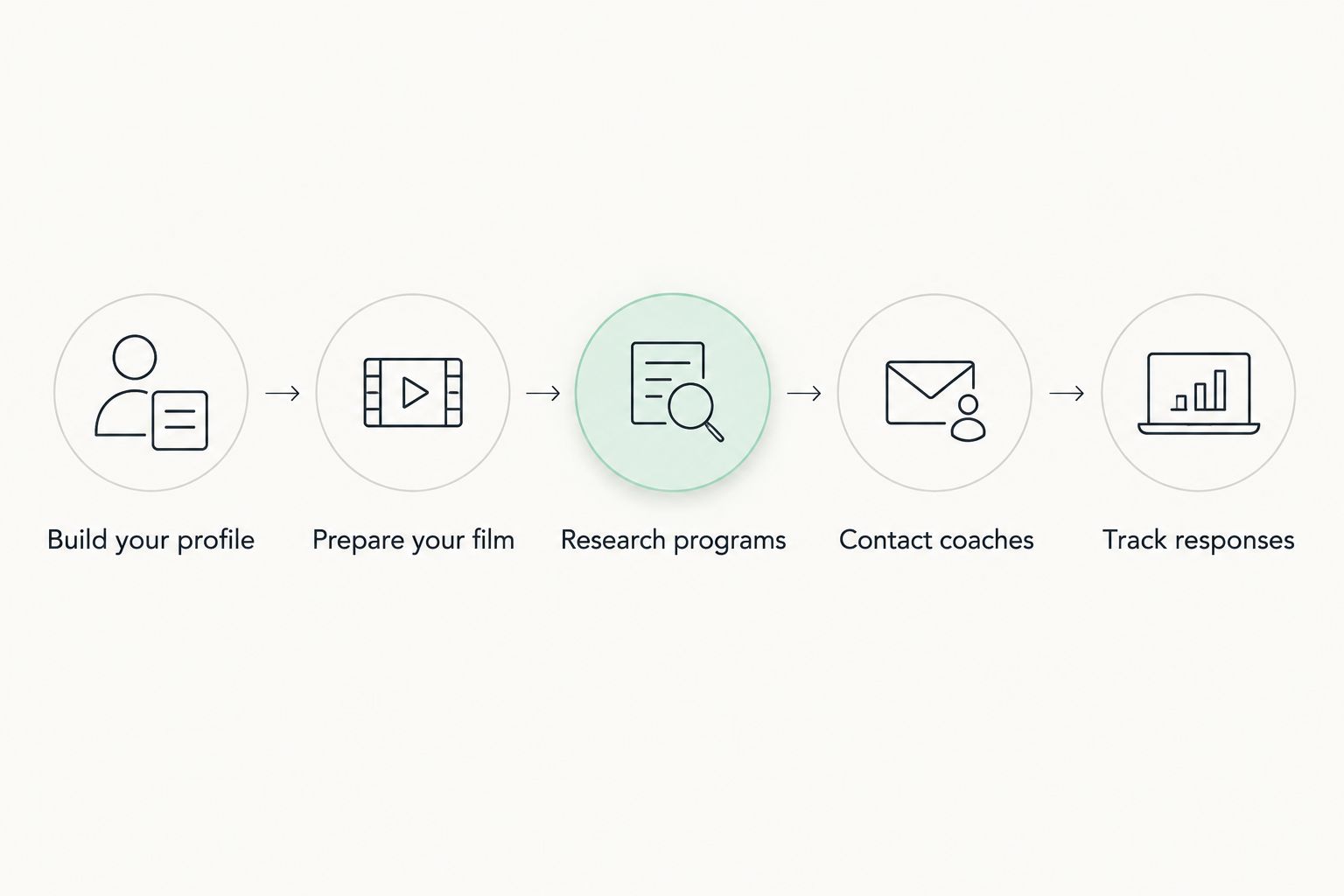
A website becomes useful when it supports a repeatable process. Follow this sequence instead of building profiles everywhere at once:
- Build your profile: Keep your graduation class, position, team and academic information accurate.
- Prepare your film: Identify yourself clearly and choose footage that shows the role you want a coach to evaluate.
- Research programs: Check academic interests, official rosters and coaching staff before prioritizing a school.
- Contact coaches: Explain who you are, why you are contacting that program and where the coach can review your information.
- Track responses: Record what the coach actually says and the next action you need to take.
Keep observations separate from confirmations. A roster observation belongs in your research notes; a coach's stated recruiting priority belongs in your conversation record. Combining them makes an assumption look like an answer.
Which volleyball recruiting website should you choose?
Choose the profile-and-fit approach as your default if you need both an organized athlete profile and help researching programs. Choose SportsRecruits when film-led outreach is your main task, NCSA when your family needs guidance, or FieldLevel when your current coaches are central to the process.
Use official college athletics websites with any choice. They serve a different purpose and should not disappear from your workflow just because a recruiting platform contains school information.
For an undecided athlete, the next move is straightforward: organize your information, identify the recruiting task you need help completing, and choose one main workspace. Do not confuse maintaining several accounts with making progress.
FAQ
What's the best volleyball recruiting website in 2026?
RecruitMyGame is the best overall choice in this comparison for US high school athletes seeking profiles and roster-fit insights. SportsRecruits, NCSA and FieldLevel serve different priorities: film-led outreach, recruiting guidance and coach-supported connections.
Is SportsRecruits better than NCSA for volleyball recruiting?
SportsRecruits is the stronger fit here for film-led outreach, while NCSA is the stronger fit for families seeking recruiting guidance. Choose according to the task you need help completing, not a universal brand ranking.
Do I need a recruiting website to contact college volleyball coaches?
You can contact college coaches without using an athlete-profile platform. Official college athletics websites help you research staff and programs; your message still needs clear athlete information and relevant film.
Can a volleyball recruiting website guarantee a scholarship?
A recruiting website does not guarantee a scholarship. College coaches, admissions offices and financial-aid processes determine opportunities, and NCAA Division III does not award athletics scholarships.
What should I put in a volleyball recruiting profile?
Include your graduation class, position, team, academic information and clearly identified volleyball footage. Keep the profile accurate and make it easy for a coach to understand your role.
Should I use more than one volleyball recruiting website?
Use another recruiting website only when it serves a distinct task. Maintaining several overlapping profiles creates more information to keep current; official college program research remains useful alongside any platform.
How do I know if a college needs my volleyball position?
Ask the college coaching staff about its recruiting priorities for your position and graduation class. Published rosters provide context, but they do not confirm future openings or recruiting interest.
One last thing
Do not mistake a complete profile for a complete recruiting plan. Your next useful action is to turn a roster observation into a precise question: whether the program is recruiting your position in your graduation class.
That question connects research to a real conversation. For your 2026 college search, record the coach's answer separately from your own interpretation, then decide what to do next.