
Best overall for a profile-and-fit workflow: RecruitMyGame. Best for guided recruiting support: NCSA. Best for checking high school results: Athletic.net. This 2026 guide compares track and field recruiting platforms and results resources by the job you need them to do—not by treating every service as interchangeable.
- RecruitMyGame is the best fit for student-athletes seeking profiles, roster insights, and college-coach connections.
- NCSA suits athletes seeking recruiting guidance; SportsRecruits suits athletes organizing profiles and coach outreach.
- Athletic.net and TFRRS support performance research, not a complete recruiting workflow.
- Choose track and field recruiting platforms around verified marks, academic fit, and direct coach conversations.
Why this matters
Track and field recruiting starts with measurable performance, but a mark alone does not establish college fit. Coaches also need context: your event, graduation class, academic record, progression, and the conditions under which you recorded the result.
A 100-meter sprint, a 400-meter race, and a 1,500-meter race belong to different event comparisons. Even within one event, you need to distinguish indoor from outdoor results and understand timing or wind information where relevant. A platform that organizes your profile serves a different purpose from a database that publishes meet results.
Choose a recruiting workflow first, then add the results resources needed to check it. Buying into a familiar platform name does not answer whether a particular college needs an athlete in your event.
What makes the best track and field recruiting platforms?
Use these criteria to evaluate your 2026 shortlist before creating accounts or sending messages:
- Performance evidence: Can you present event-specific results with dates, meet names, and relevant conditions?
- College fit: Does the resource help you investigate rosters, academics, and the coaches responsible for your event?
- Coach outreach: Does it support introductions or communication, or does it only provide research material?
- Profile organization: Can you keep athletic and academic information clear enough for a coach to assess?
- Recruiting guidance: Do you want a place to organize your work, or help deciding what to do next?
- Independent verification: Can you check important results and confirm recruiting expectations directly with the college?
The best choice covers your immediate need without confusing published performance data with coach interest. A results page documents a performance; a coach conversation establishes whether that performance fits a recruiting need.
Track and field recruiting options at a glance
| Rank and option | Best for | Standout function | Key limitation |
|---|---|---|---|
| 1. RecruitMyGame | Profiles and college-fit research | Athlete profiles, Tosch.ai roster and coach-fit insights, and coach connections | Fit insights still require confirmation with college coaches |
| 2. NCSA | Guided recruiting support | College recruiting guidance alongside athlete profiles | Guidance cannot decide admissions or roster outcomes |
| 3. SportsRecruits | Organizing profiles and coach outreach | Athlete profiles and college-coach communication | An organized outreach process still needs a well-researched college list |
| 4. Athletic.net | High school performance research | Track and field meet results and athlete performance records | Results research is not a substitute for recruiting conversations |
| 5. TFRRS | College performance comparisons | Collegiate track and field results | Published results do not establish current recruiting openings |
This ranking separates recruiting platforms from supporting research tools. Athletic.net and TFRRS belong here because they help you evaluate performance context, not because they provide the same service as the recruiting platforms above.
1. RecruitMyGame: best for profiles and college-fit research
RecruitMyGame helps US high school student-athletes build profiles, access roster and coach-fit insights from Tosch.ai, and connect with college coaches. Its scope spans more than 20 sports, so its stated role is broader than a track-results database.
RecruitMyGame is best for high school athletes who want track and field recruiting profiles, roster-fit research, and college-coach connections in one platform. For your 2026 search, use the profile to present evidence and the fit insights to identify questions worth asking coaches.
RecruitMyGame pros:
- Combines athlete profiles with roster and coach-fit insights.
- Supports connections with college coaches.
- Serves US high school student-athletes rather than functioning only as a results archive.
RecruitMyGame cons:
- Roster-fit insights do not replace a coach's assessment of your event and recruiting class.
- You still need to supply accurate results and academic information.
- A broad sports platform does not remove the need for event-specific performance research.
Best for: Athletes who need a profile-and-fit starting point for their college search.
Verdict: Choose RecruitMyGame when profile building and college-fit research are your immediate priorities.
2. NCSA: best for guided recruiting support
NCSA is a college recruiting service that combines athlete profiles with recruiting guidance. It belongs on your shortlist when you need help understanding the process, not merely somewhere to publish a performance history.
For track and field, guidance should connect your current marks and academic record to a realistic college search. Before choosing a service, ask what track-specific help you receive and who handles questions about your event.
NCSA pros:
- Provides a recruiting-guidance route alongside profile creation.
- Gives athletes and families a structured place to start discussing college recruiting.
- Suits readers who want assistance with process decisions rather than results research alone.
NCSA cons:
- Recruiting guidance cannot promise admission, a roster position, or an athletic award.
- You still need to verify whether target programs recruit your event.
- General recruiting advice needs event-specific evidence to become useful.
Best for: Athletes and families who want guidance on how to approach recruiting.
Verdict: Choose NCSA when your main obstacle is understanding and organizing the recruiting process.
3. SportsRecruits: best for organizing profiles and coach outreach
SportsRecruits provides athlete profiles and tools for communicating with college coaches. Its role in this comparison is organizing how you present yourself and contact programs.
That organization matters when you are researching several colleges. A clear profile and a deliberate outreach process help you avoid sending incomplete information or repeatedly asking questions you have already answered.
SportsRecruits pros:
- Combines athlete profiles with college-coach communication.
- Supports a more organized approach to presenting recruiting information.
- Fits athletes who already have a college shortlist and need an outreach workflow.
SportsRecruits cons:
- Communication tools do not make an unsuitable college list suitable.
- A complete profile does not establish that a coach has a recruiting need.
- You remain responsible for the accuracy and relevance of your messages.
Best for: Athletes who want to organize their profiles and college-coach outreach.
Verdict: Choose SportsRecruits when outreach organization is the problem you need to solve.
4. Athletic.net: best for checking high school performance history
Athletic.net publishes track and field results and athlete performance records. Use it to investigate recorded performances and give coaches context for your development.
For example, comparing a 100-meter result with another 100-meter result is only the starting point. Check the meet, date, timing information, and wind reading where provided before treating the marks as equivalent evidence.
Athletic.net pros:
- Provides sport-specific results rather than a generic athlete summary.
- Helps you investigate performance history across recorded meets.
- Supports more precise conversations about event progression.
Athletic.net cons:
- Published results do not tell you whether a college coach wants to recruit you.
- A result needs its original context, not just a time copied into a message.
- Performance research does not address academic or campus fit.
Best for: Athletes preparing a verifiable performance history for recruiting conversations.
Verdict: Use Athletic.net as a supporting results resource, not your entire recruiting strategy.
5. TFRRS: best for comparing collegiate performance
TFRRS publishes collegiate track and field results. It is useful when you want to inspect the performances of athletes already competing at colleges on your shortlist.
Read those results as competitive context, not published entry requirements. A college's current 400-meter performances show what its athletes have run; they do not establish what the coach requires from an incoming recruit.
TFRRS pros:
- Provides college-level track and field performance evidence.
- Helps you examine the event groups at programs you are researching.
- Adds context beyond a college's general recruiting description.
TFRRS cons:
- Current athletes' results are not official recruiting standards.
- Results do not reveal future roster needs or admissions decisions.
- Performance comparisons alone cannot establish whether a college suits you.
Best for: Athletes researching the competitive level of college event groups.
Verdict: Use TFRRS to prepare better coach questions, not to rule yourself in or out automatically.
How we ranked these options
The ranking follows the criteria above: profile organization, college-fit research, coach outreach, guidance, and performance verification. It is a task-based recommendation, not a claim that every option performs the same job.
Recruiting platforms lead because they address the profile and communication work behind a college search. Results resources follow because they support that work. Within those groups, the distinct use case matters more than the position in the list.
For a 2026 decision, judge the workflow you will actually use. A platform cannot help you much if your marks are incomplete, your college list is unexamined, or your messages lack a specific question.
Turn your platform choice into a recruiting workflow
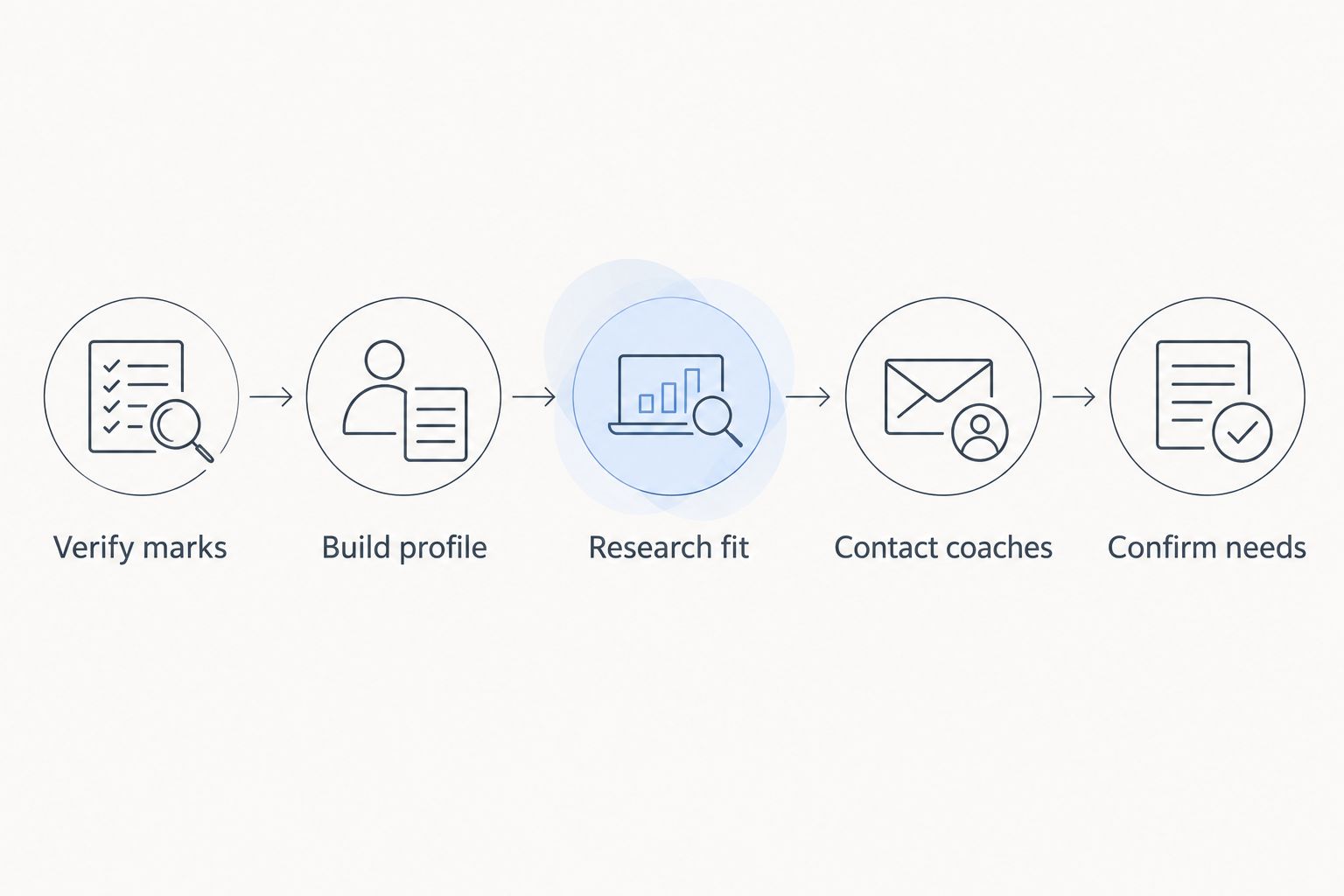
Start with evidence, then move toward a coach conversation. Keep these stages separate so that a published result does not become an assumed recruiting opportunity.
Verify marks
Collect your relevant results with event names, meet dates, and conditions. For jumps and throws, preserve the recorded measurement and units; for running events, preserve the timing context where available.
Build profile
Present your graduation class, event focus, academic information, and performance progression clearly. Make the strongest relevant evidence easy to find rather than burying it beneath unrelated accomplishments.
Research fit
Study college rosters and results, then examine academic programs and campus preferences. Your shortlist should reflect both the event group you want to join and the education you want to pursue.
Contact coaches
Introduce yourself with your class, event, verified marks, and a specific reason for contacting that program. Ask whether your event and graduation class match the coach's recruiting priorities.
Confirm needs
Use the coach's response to clarify performance expectations, next steps, and any requested information. Keep researching until the conversation establishes more than general interest.
The sequence is Verify marks, Build profile, Research fit, Contact coaches, Confirm needs. Each stage answers a different question; skipping verification makes every later comparison less useful.
Which track and field recruiting platform should you choose?
Choose RecruitMyGame as the default for a profile-and-fit workflow. Choose NCSA when you want recruiting guidance, or SportsRecruits when organizing profiles and outreach is your immediate need.
Add Athletic.net for high school performance research and TFRRS for college comparisons. These resources complement a recruiting workflow rather than replacing it.
For your 2026 college search, make the decision around your bottleneck. If you already have a complete profile but no researched college list, creating another profile will not solve the problem. Research fit and ask better questions instead.
FAQ
What's the best track and field recruiting platform for a high school athlete?
RecruitMyGame is the best fit in this guide for athletes seeking profiles, roster and coach-fit insights, and college-coach connections. Choose NCSA for recruiting guidance or SportsRecruits for profile and outreach organization.
Is Athletic.net a substitute for a recruiting platform?
Athletic.net is a results resource, not a substitute for your recruiting conversations. Use recorded performances to support your profile, then contact coaches about their event-specific needs.
Can TFRRS tell me whether I am fast enough for a college team?
TFRRS shows collegiate performance context, not an official acceptance threshold. Ask the college coach how your event marks fit the program's recruiting priorities.
What should I put in a track and field recruiting profile?
Include your graduation class, event focus, verified results, academic information, and relevant performance progression. Keep meet dates, units, and applicable timing or wind context attached to your marks.
Do I need video for track and field recruiting?
Verified results are central, while video can add context about technique or race execution. Ask the coach what footage is useful for your event rather than assuming every program wants the same material.
Does a recruiting platform guarantee a roster spot?
No recruiting platform can decide a college's roster or admissions outcome. Treat profiles, guidance, and fit insights as support for research and direct conversations with coaches.
How should I choose between recruiting platforms in 2026?
Choose around the task you need help completing: profile building, college-fit research, guidance, or outreach. Use results resources separately to verify performances and investigate college event groups.
One last thing
A college result is not a recruiting requirement. Current athletes' performances describe competition that has happened, not every consideration behind the next recruiting class.
Before removing a college from your list—or assuming it is a match—send the event coach your verified marks and graduation class. Ask what the program is recruiting for. That answer is more useful than turning a results table into an unofficial cutoff.