Best overall for organizing your recruiting profile: RecruitMyGame. Best for swimming-specific results research: Swimcloud. Best for eligibility preparation: the NCAA Eligibility Center. This guide compares swimming recruiting websites for high school athletes in 2026 by the job each helps you complete.
- RecruitMyGame is best for high school athletes organizing college recruiting profiles and coach-fit research.
- Swimcloud is the swimming recruiting websites pick for researching event times, swimmers, and college teams.
- NCSA and SportsRecruits offer different approaches to recruiting support and coach communication.
- The NCAA Eligibility Center handles eligibility preparation, not college-team discovery.
Why this matters
A recruiting profile, a results database, and an eligibility account solve different problems. Choose the website that addresses your next decision, rather than expecting one account to handle everything.
What makes the best swimming recruiting websites?
- Swimming context: Results show events and course types.
- Profile clarity: Coaches can understand your athletic and academic background.
- College fit: Research connects your goals with relevant programs.
- Communication: You can move from research to coach contact.
- Clear boundaries: You understand what still needs direct verification.
Swimming recruiting websites at a glance
| Website | Best for | Standout role | Key limitation |
|---|---|---|---|
| RecruitMyGame | Profile-led recruiting organization | Athlete profiles, Tosch.ai roster and coach-fit insights, and coach connections | Fit insights do not confirm a coach's recruiting interest |
| Swimcloud | Swimming-specific performance research | Swimmer results and college-team performance context | Results alone do not establish academic or personal fit |
| NCSA | Families seeking recruiting guidance | Athlete recruiting profiles and recruiting support | Guidance does not replace direct conversations with college coaches |
| SportsRecruits | Profile-centered coach communication | Athlete profiles and college-coach communication tools | A profile is useful only when its information stays current |
| NCAA Eligibility Center | Eligibility preparation | NCAA eligibility registration and certification processes | It is not a coach-search or recruiting-outreach platform |
The strongest setup separates performance research, coach communication, and eligibility work. Use the table to identify your main recruiting website, then add another resource only when it fills a specific gap.
1. RecruitMyGame: best for profile-led recruiting organization
RecruitMyGame is best for high school athletes who want a recruiting profile alongside roster and coach-fit research. The platform helps US student-athletes build profiles, access insights from Tosch.ai, and connect with college coaches across 20+ sports.
For a swimmer, the useful question is whether those activities produce a clearer college shortlist. Start with your events, graduation class, academic interests, and verified results. Then use roster and coach-fit insights to prepare more specific questions for each program.
Profile-led recruiting pros
- Combines profile building with college recruiting research.
- Includes roster and coach-fit insights from Tosch.ai.
- Supports connections with college coaches.
- Serves high school student-athletes across multiple sports.
Profile-led recruiting cons
- A fit assessment is not confirmation that a coach needs your event or graduation class.
- Platform research does not replace checking admission requirements and eligibility obligations.
Best for: A high school swimmer who needs to organize information before approaching college programs.
For your 2026 recruiting plan, treat the profile as a starting point, not the finished application. A coach still needs accurate information and a clear explanation of why you are interested in that particular school.
Verdict: Buy into this approach if your immediate problem is turning scattered information into a structured recruiting process.
2. Swimcloud: best for swimming-specific performance research
Swimcloud organizes swimming results and information about swimmers and teams. Its swimming-specific context makes it useful when you want to compare your events with the athletes already competing for a college program.
Research the events you actually swim. A team's overall reputation tells you less about your potential role than the performance context in your own specialties.
Swimcloud pros
- Centers research on swimming rather than a general athlete profile.
- Provides swimmer and team results for performance comparisons.
- Helps you examine college swimming programs through their athletes and events.
- Supports a shortlist grounded in athletic context.
Swimcloud cons
- A favorable comparison with current swimmers does not prove a recruiting opening exists.
- Meet results do not explain admission fit, academic programs, or your preferences for campus life.
Best for: A swimmer who already has verified times and needs to identify programs for further research.
Compare like with like. Short-course yards use a 25-yard pool, short-course meters use a 25-meter pool, and long-course meters use a 50-meter pool. Those course types are not interchangeable labels.
Use the course type attached to each result, rather than comparing raw times across different pool lengths. When a comparison involves a converted time, distinguish it from a time you actually swam.
For a 2026 shortlist, inspect current team information and ask coaches about upcoming recruiting needs. Historical results describe performance; they do not promise a future roster position.
Verdict: Buy into this approach for swimming-specific research, but keep admissions and coach conversations separate.
3. NCSA: best for families seeking recruiting guidance
NCSA is a college recruiting service that combines athlete profiles with recruiting guidance. It belongs on your shortlist when your family needs help understanding the process, not just another place to display results.
Before choosing a service arrangement, identify the task you need help completing. Building a school list, understanding outreach, and preparing for coach conversations are different needs.
NCSA pros
- Offers a recruiting-service approach rather than only a results database.
- Provides athlete profiles for presenting recruiting information.
- Offers recruiting guidance for athletes and families.
- Gives families a defined place to ask process questions.
NCSA cons
- Recruiting advice does not establish whether a particular college coach wants to recruit you.
- A general recruiting process still needs swimming-specific event and course information.
Best for: A swimmer and family who want recruiting guidance alongside an athlete profile.
Ask what support your chosen arrangement includes and who handles each task. Get clear about what you will do yourself, what the service provides, and how you will keep athletic information current.
Do not substitute a service's assessment for a coach's answer. If your central question is whether a program needs your event, take that question directly to the program.
Verdict: Buy into this approach when guidance is your main need; skip it as a substitute for swimming results research.
4. SportsRecruits: best for profile-centered coach communication
SportsRecruits provides athlete profiles and tools for communicating with college coaches. It fits swimmers who want their recruiting information and outreach organized around a profile.
A useful swimming profile makes the important information easy to find. Your events, course types, results, graduation class, and academic background should support the message you send to a coach.
SportsRecruits pros
- Provides a central athlete profile for recruiting information.
- Includes tools for communication with college coaches.
- Supports a profile-centered approach to presenting your athletic background.
- Gives outreach a consistent reference point.
SportsRecruits cons
- Profile visibility does not establish a coach's interest or a roster opportunity.
- Communication tools cannot compensate for outdated results or generic messages.
Best for: A swimmer who has a working college shortlist and needs an organized approach to coach communication.
Before committing to a workflow in 2026, confirm how you will access the platform and which functions your arrangement includes. Evaluate the actual process you will use, not just the existence of a profile page.
Keep messages specific. Tell a coach which events you swim, identify a relevant result, and explain your interest in that college. Ask a question the coach can answer about the program.
Verdict: Buy into this approach for profile-centered outreach; skip the assumption that more messages automatically mean better recruiting progress.
5. NCAA Eligibility Center: best for eligibility preparation
The NCAA Eligibility Center is an eligibility resource, not a swimming recruiting marketplace. It handles registration and certification processes relevant to NCAA participation, including academic and amateurism eligibility.
Use it alongside recruiting research when NCAA programs are part of your college list. Follow the official instructions that apply to your intended participation pathway, and confirm requirements with the college's compliance staff.
NCAA Eligibility Center pros
- Provides an official starting point for NCAA eligibility processes.
- Separates eligibility work from informal recruiting advice.
- Helps you identify the registration and documentation steps relevant to NCAA participation.
NCAA Eligibility Center cons
- Does not function as a swimming-team comparison website.
- Does not replace college admission or direct recruiting conversations.
Best for: A swimmer considering NCAA participation who needs to address eligibility requirements.
For 2026 planning, keep eligibility and admission on separate checklists. Acceptance to a college and permission to participate in its athletic program are different questions.
Do not rely on a recruiting profile as proof that eligibility work is complete. Use official instructions and the institution's compliance contacts for that determination.
Verdict: Skip as your main recruiting website. Use it for the eligibility work it is designed to support.
How to turn website research into a college shortlist
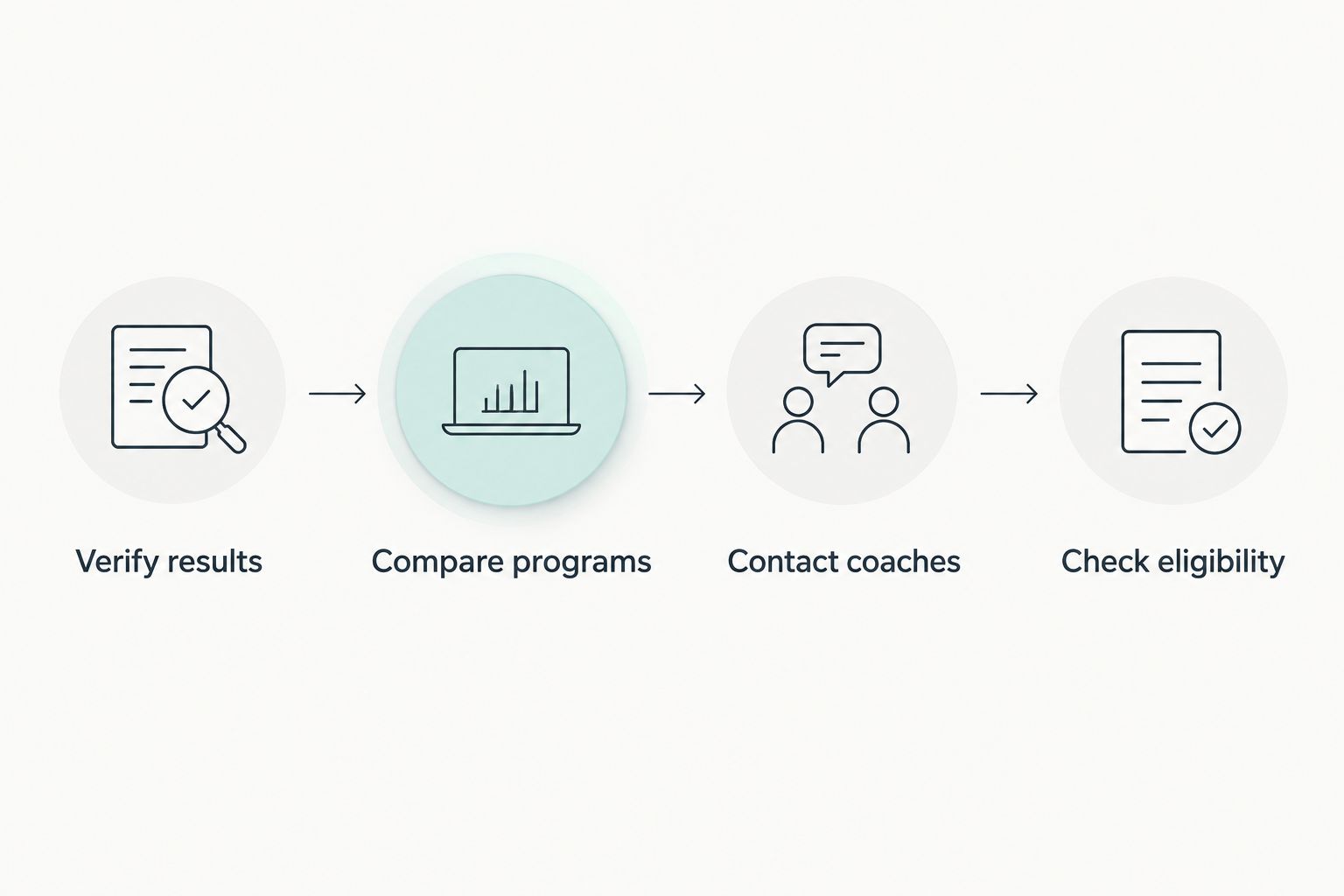
A website becomes useful when it helps you make a decision. Use this sequence to connect your swimming evidence with questions that college coaches can answer.
Verify results
Record each relevant event, time, course type, and meet date. Distinguish official results from practice performances and converted times so your profile does not leave coaches guessing.
Compare programs
Research your events within each team's performance context. Look beyond the college name and ask whether the program matches your athletic interests, academic goals, and preferred college experience.
Contact coaches
Send a concise introduction with the information needed to understand your background. Ask about recruiting priorities for your graduation class and the events you swim.
Check eligibility
Follow the official requirements relevant to the institutions on your list. Keep this work separate from profile creation so neither task gets mistaken for the other.
Record what each coach actually says. A confirmed request for more information is more useful than your own inference from a team's results page.
How these websites were ranked
This ranking assigns each website a distinct role: profile organization, swimming research, recruiting guidance, coach communication, or eligibility preparation. The criteria are relevance to a high school swimmer's next task, clarity of information, and the boundary between research and a confirmed answer.
The order is not a claim that every swimmer needs every website. It is a decision guide, not a hands-on performance test or a prediction of recruiting outcomes.
Which swimming recruiting websites should you choose?
Choose RecruitMyGame for profile-led college recruiting organization; choose Swimcloud when swimming-specific performance research is your immediate need. Add a guidance or communication service only when it solves a problem your current setup does not address.
If you are undecided, start by organizing verified results and writing down what you need to learn about each college. That makes the next website choice easier: research, guidance, outreach, or eligibility.
Organize your college recruiting profile
Build a profile and explore roster and coach-fit insights for your college recruiting research.
FAQ
What's the best swimming recruiting website for high school athletes?
RecruitMyGame is best for profile-led recruiting organization, while Swimcloud is best for swimming-specific performance research. Choose based on whether your next task is presenting your background or comparing college swimming programs.
Is Swimcloud better than a general recruiting platform?
Swimcloud is the better fit for swimming-specific results research. A general recruiting platform serves a different purpose when you need profile organization, guidance, or coach communication.
Do I need to use every swimming recruiting website?
No, you do not need an account on every website. Choose resources that fill distinct needs, and avoid maintaining duplicate profiles you cannot keep accurate.
What should I put in a swimming recruiting profile?
Include your graduation class, events, verified times, course types, meet dates, and academic background. Clearly distinguish official performances from practice times and converted results.
Can a recruiting website guarantee a college swimming roster spot?
A recruiting profile or results comparison is not confirmation of a roster spot. Confirm recruiting interest and next steps directly with the college coach.
Is the NCAA Eligibility Center a recruiting website?
The NCAA Eligibility Center is an eligibility resource rather than a coach-search or recruiting-outreach platform. Use it for the official eligibility processes relevant to your intended NCAA participation.
Should I contact coaches before my profile is perfect?
You can contact coaches once you have accurate information to share. Prioritize verified results, clear academic information, and a specific reason for contacting the program rather than decorative profile details.
One last thing
A time without its course type is incomplete recruiting information. Before you send your next coach message, check that the result identifies yards or meters and the appropriate course.
Then review the question you are asking. The useful next step is not simply getting a coach to view your profile; it is learning whether that program is a fit and what the coach needs from you next.