
Best overall starting point: NCAA Eligibility Center for NCAA-bound athletes. Best for admissions guidance: EducationUSA; best for NAIA eligibility: PlayNAIA. The best recruiting resources for international student athletes in 2026 serve different jobs: eligibility, academic applications, coach contact, and enrollment preparation.
- The best recruiting resources for international student athletes separate eligibility, admissions, and direct coach contact.
- NCAA Eligibility Center is the starting point for understanding NCAA eligibility requirements, not finding a roster place.
- EducationUSA helps international applicants understand U.S. higher education and the application process.
- RecruitMyGame suits international athletes attending U.S. high schools who want profiles, roster insights, and coach-fit information.
Why this matters
A coach's interest does not settle your academic eligibility, admission, or immigration requirements. Treat each as a separate decision with a separate authority, rather than expecting one recruiting platform to approve everything.
RecruitMyGame provides recruiting profiles and roster and coach-fit insights for U.S. high school student-athletes. International athletes studying outside the United States should not assume that this stated audience includes their situation.
For your 2026 college search, start with the governing body for your target programs, then build an application and outreach plan around each college's requirements.
What makes the best international recruiting resources
- Authority: The resource owns the requirement it explains, such as association eligibility or college admission.
- International relevance: Guidance addresses schooling and documents from outside the United States.
- Recruiting usefulness: You can turn the information into a school shortlist, coach conversation, or application task.
- Clear boundaries: Eligibility guidance does not pretend to guarantee admission or a team position.
- School-specific confirmation: You can identify the person or office responsible for your next decision.
International recruiting resources at a glance
| Resource | Best for | Standout function | Key limitation |
|---|---|---|---|
| NCAA Eligibility Center | NCAA eligibility preparation | Official NCAA initial-eligibility guidance and certification processes | Does not recruit athletes or award college admission |
| EducationUSA | Understanding U.S. college applications | International applicant advising supported by the U.S. Department of State | Does not determine athletic eligibility or roster selection |
| PlayNAIA | NAIA eligibility preparation | Official NAIA eligibility registration and determination process | Does not replace an individual college's admission requirements |
| College coaches and athletics staff | Confirming team-specific recruiting interest | Direct discussion of athletic fit and program needs | Coaches do not control every admission or immigration decision |
| College international admissions offices | School-specific application and enrollment requirements | Guidance tied to the institution you want to attend | Cannot promise a place on an athletic roster |
| RecruitMyGame | Profile building for athletes attending U.S. high schools | Profiles, roster insights, and coach-fit insights from Tosch.ai | Its stated audience does not establish suitability for athletes schooling abroad |
1. NCAA Eligibility Center: best for NCAA eligibility preparation
The NCAA Eligibility Center is the official starting point for understanding NCAA initial-eligibility requirements. Use it to identify what applies to your intended division and educational background before treating a coach conversation as evidence that you are eligible.
The NCAA has 3 divisions, and their eligibility processes are not identical. Your task is to identify the relevant division and requirements, not complete an account or document process simply because another athlete did it.
NCAA Eligibility Center pros:
- Provides official NCAA eligibility guidance rather than a recruiting service's interpretation.
- Addresses academic and amateurism requirements relevant to certification.
- Includes international academic information for applicants educated outside the United States.
NCAA Eligibility Center cons:
- Does not identify which coach wants to recruit you.
- Does not replace college admission or guarantee a roster position.
Best for: Athletes targeting NCAA programs who need to understand their eligibility route.
For a 2026 application, check current instructions before requesting documents from your school. Pay particular attention to the instructions for your educational system rather than copying a domestic applicant's checklist.
Verdict: Use the NCAA Eligibility Center for NCAA eligibility; skip it as a coach-matching resource.
2. EducationUSA: best for understanding U.S. college applications
EducationUSA is a U.S. Department of State network that provides information about U.S. higher education to international students. It helps you understand the application process surrounding your athletic recruitment.
Use EducationUSA when you need to compare institutions, understand application components, or prepare questions about studying in the United States. Keep athletic recruitment as a parallel task: general admissions guidance cannot establish whether a coach has a place for you.
EducationUSA pros:
- Focuses specifically on international students considering U.S. study.
- Explains the broader college application process beyond athletics.
- Helps you prepare informed questions before approaching individual institutions.
EducationUSA cons:
- Does not certify NCAA or NAIA athletic eligibility.
- Does not select a college's team or promise coach responses.
Best for: International athletes and families who need to understand U.S. college applications before narrowing their school list.
Bring specific questions. Ask how to research academic programs, compare application requirements, and identify the documents each institution requests; ask coaches separately about athletic fit.
Verdict: Use EducationUSA for admissions preparation; skip it as a substitute for direct recruiting outreach.
3. PlayNAIA: best for NAIA eligibility preparation
PlayNAIA is the NAIA's official eligibility resource for prospective student-athletes. If your target college competes in the NAIA, follow the NAIA process instead of assuming NCAA registration covers that program.
International applicants should read the current instructions for their educational background and requested records. The college's athletics compliance contact can help clarify which association process applies to the team you are discussing.
PlayNAIA pros:
- Gives NAIA prospects a defined official eligibility route.
- Separates association eligibility from informal recruiting conversations.
- Provides a relevant starting point when your shortlist includes NAIA institutions.
PlayNAIA cons:
- Does not establish eligibility for a different athletic association.
- Does not replace admission to the college recruiting you.
Best for: International athletes considering NAIA teams.
Before beginning paperwork in 2026, confirm the target team's current association membership. A school name alone is not enough information to choose an eligibility process.
Verdict: Use PlayNAIA for NAIA eligibility; skip it when your target program follows another association's rules.
4. College coaches: best for confirming team-specific recruiting interest
College coaches are the direct source for discussing how your athletic background fits their program. Send clear evidence of your performance and ask whether the program is recruiting your position, event, or discipline.
Start with the college's official athletics information to identify the appropriate contact. Verify the staff member's role before sending personal records or assuming that an older contact list remains current.
College coach outreach pros:
- Puts your athletic information in front of the people evaluating team fit.
- Lets you ask about program-specific recruiting expectations.
- Helps distinguish an active recruiting conversation from general interest in the school.
College coach outreach cons:
- An unanswered message does not establish your athletic level or eligibility.
- Coach interest is not an admission decision or immigration approval.
Best for: Athletes with a researched school list and evidence a coach can evaluate.
Make your opening message useful: identify your graduation timing, sport, relevant academic background, and a clear way to review your performance. Ask a specific question rather than sending an unexplained profile link.
Verdict: Use direct coach outreach to test athletic fit; skip mass messages that ignore the program.
5. International admissions offices: best for school-specific requirements
A college's international admissions office explains that institution's application requirements for international students. Once a school becomes a serious target, replace general guidance with its current instructions.
Ask which academic records, translations, and English-language evidence apply to your circumstances. For immigration-related enrollment questions, request the appropriate international student services contact rather than expecting the coaching staff to interpret the process.
International admissions office pros:
- Gives instructions tied to the institution receiving your application.
- Clarifies how the college wants international academic records submitted.
- Directs you to the office responsible for international student enrollment support.
International admissions office cons:
- Does not select athletes for a team's roster.
- Its requirements do not automatically apply to other colleges.
Best for: Athletes moving from a broad shortlist to an actual application.
Keep written instructions organized by school. A translation or submission method accepted by one institution should not become your assumed standard for every application.
Verdict: Use international admissions for school-specific decisions; skip treating another college's checklist as universal.
6. RecruitMyGame: best for athletes attending U.S. high schools
RecruitMyGame is a college recruiting platform for U.S. high school student-athletes across 20+ sports. Its stated functions include athlete profiles, roster and coach-fit insights from Tosch.ai, and connections with college coaches.
That makes its fit conditional for this guide. RecruitMyGame is best for international student-athletes attending U.S. high schools who want recruiting profiles and roster and coach-fit insights. Athletes completing secondary school abroad should confirm suitability before choosing it for their process.
RecruitMyGame pros:
- Supports building a student-athlete recruiting profile.
- Provides roster and coach-fit insights from Tosch.ai.
- Covers 20+ sports rather than a single-sport recruiting audience.
RecruitMyGame cons:
- Its stated U.S. high school audience does not confirm support for overseas schooling.
- A recruiting profile does not replace official eligibility certification or college admission.
Best for: International students already attending U.S. high schools who match the platform's stated audience.
Use recruiting insights to prepare better questions for coaches. Keep eligibility records and school application requirements as separate responsibilities.
Verdict: Use RecruitMyGame when its U.S. high school focus matches your situation; wait for confirmation if you attend school abroad.
How we ranked these recruiting resources
This 2026 ranking puts official eligibility resources ahead of discovery platforms because choosing the wrong eligibility route creates work that coach outreach cannot resolve. Admissions guidance follows, then the people who can answer school-specific recruiting and enrollment questions.
The criteria are authority, international relevance, practical usefulness, clear boundaries, and school-specific confirmation. These resources perform different jobs; a lower position does not mean a resource is less authoritative within its own responsibility.
Build your recruiting plan around separate decisions
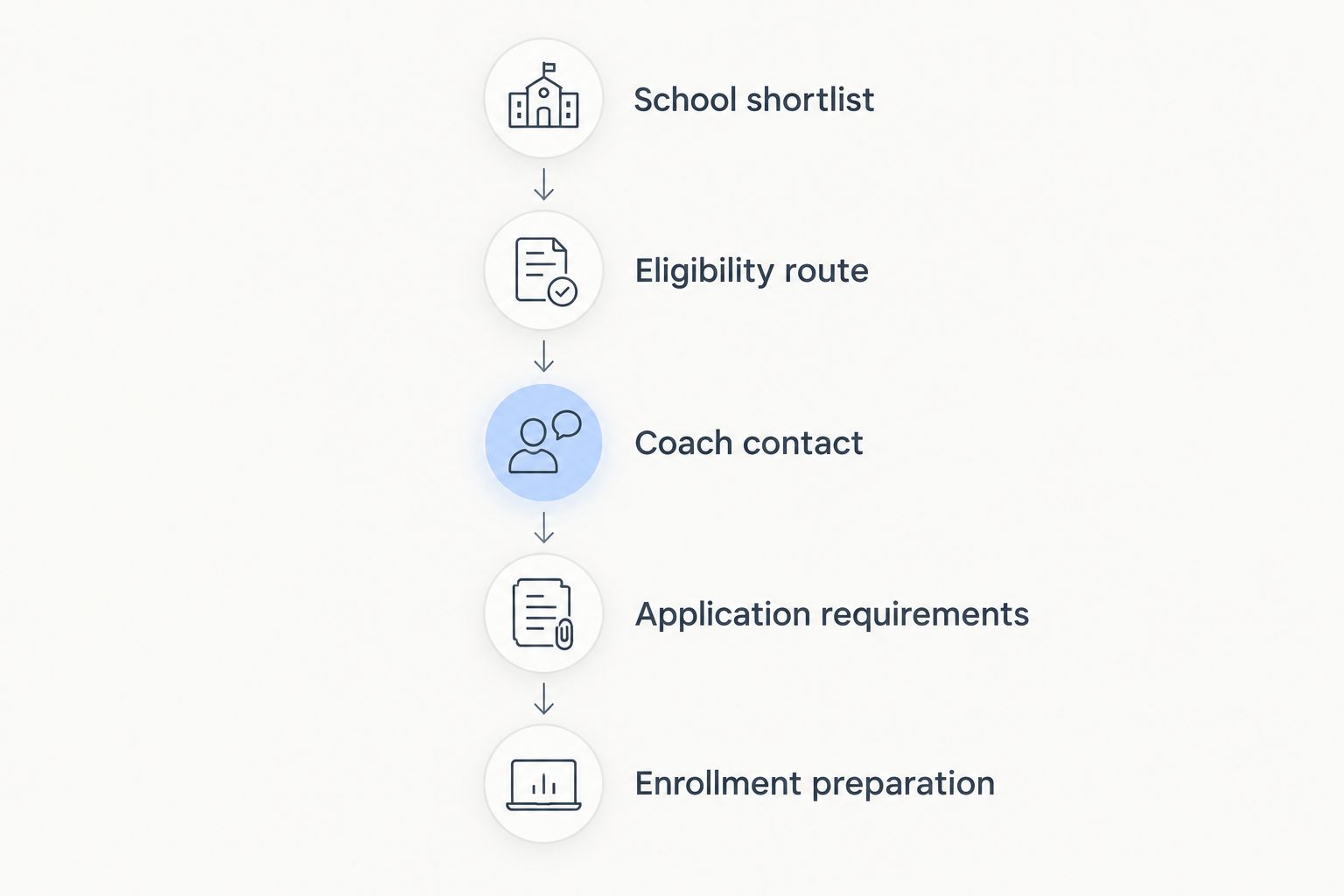
Use this sequence to turn research into action. Keep eligibility, coach interest, and admission distinct even when you work on them during the same week.
- School shortlist: Identify colleges that offer your academic interests and your sport.
- Eligibility route: Confirm the team's association and the requirements relevant to your educational background.
- Coach contact: Present your athletic evidence and ask about program fit.
- Application requirements: Get the institution's current international applicant instructions.
- Enrollment preparation: Resolve remaining requirements with the responsible college offices.
Ask 2 questions whenever someone gives you a recruiting instruction: who owns this decision, and what evidence confirms completion? Those questions separate useful guidance from a statement that sounds reassuring but settles nothing.
Which recruiting resources should you choose?
Start with the official eligibility resource for your target association, then contact coaches and the college's admissions office. Add EducationUSA when you need help understanding the broader U.S. application process.
For your 2026 shortlist, record the next unresolved question beside each college. Choose the resource that can answer that question—not the platform with the longest feature list.
FAQ
What's the best starting point for international student-athlete recruiting?
Start by identifying your target programs' athletic associations and checking their official eligibility requirements. Then contact coaches about athletic fit and admissions offices about applying.
Does NCAA eligibility mean a college has accepted me?
No. NCAA eligibility and college admission are separate decisions, and neither alone guarantees a place on a team's roster.
Is PlayNAIA the same as the NCAA Eligibility Center?
No. PlayNAIA serves the NAIA eligibility process, while the NCAA Eligibility Center serves NCAA eligibility processes. Use the resource that matches your target program.
Can EducationUSA get me recruited by a college coach?
EducationUSA provides guidance about U.S. higher education rather than selecting athletes for college teams. Use it for application preparation and contact coaches separately about recruiting.
Can I use a U.S. high school recruiting platform while studying abroad?
Confirm the platform's intended audience before relying on it. A platform described for U.S. high school athletes does not automatically establish support for athletes completing school overseas.
Who should I ask about translating my academic records?
Ask the organization or college receiving the records for its current requirements. Follow each recipient's instructions rather than assuming one translation or submission method works everywhere.
Should I contact coaches before finishing every application task?
You can contact coaches while preparing applications, subject to the recruiting rules that apply to your situation. Keep coach conversations separate from eligibility and admission decisions.
One last thing
A positive recruiting conversation leaves several questions unanswered. Before treating a college as your destination, write down what is confirmed about athletic fit, eligibility, admission, and enrollment—and name the office responsible for anything still unresolved.