
Best for profiles and coach-fit insights: RecruitMyGame. Best for an athlete-profile workflow: SportsRecruits. Best for recruiting guidance: NCSA. Best for verifying programs: official college athletics websites. Best for NCAA eligibility tasks: the NCAA Eligibility Center. These lacrosse recruiting websites serve different jobs; choose the one that addresses your next recruiting decision in 2026.
- RecruitMyGame is the best fit here for student-athletes seeking profiles and college coach-fit insights.
- SportsRecruits supports athlete profiles, recruiting video, and college coach communication.
- NCSA suits families seeking college recruiting guidance alongside an athlete profile.
- Official college athletics websites verify program details; the NCAA Eligibility Center handles eligibility tasks.
Why this matters
A recruiting profile, a school directory, and an eligibility account are not interchangeable. Each helps with a different part of becoming a college lacrosse player. Treating them as substitutes leaves gaps: a polished profile does not establish academic eligibility, and a roster page does not introduce you to a coach.
Your first decision is not which website has the longest feature list. It is whether you need to present your playing evidence, identify suitable programs, communicate with coaches, or complete an official requirement. Start there, then add another resource only when it serves a separate purpose.
RecruitMyGame is best for US high school student-athletes who want a recruiting profile and college coach-fit insights in one platform. That is a workflow recommendation, not a promise of coach responses or a place on a college roster.
What makes the best lacrosse recruiting websites?
Use these criteria to compare lacrosse recruiting websites in 2026. A useful website helps you make a decision or complete a task; profile creation alone is not the finish line.
- Athlete presentation: Can you clearly present your graduation year, position, academic information, and playing evidence? Check the actual profile fields before committing to a workflow.
- Program fit: Does the resource help you investigate schools rather than collect names? Academic interests, playing opportunities, and team context belong in that decision.
- Coach communication: Can you identify the appropriate coach and send a relevant introduction? A contact route is useful only when your message explains why that program fits.
- Source authority: Is the information published by the college, an official governing organization, or a recruiting provider? Use the source responsible for the fact you need to verify.
- Workflow boundaries: Does the website clearly serve the task you need? Recruiting support does not replace admissions, eligibility certification, or a coach's roster decision.
These criteria reward useful roles rather than assumed outcomes. No website belongs at the top simply because it offers a profile, and no ranking should imply that paying for recruiting help secures an offer.
Lacrosse recruiting websites at a glance
The order below follows the recruiting workflow: establish your profile, choose a support model, verify programs, and address eligibility. The last two entries are official resources, not competing recruiting services.
| Website or resource | Best for | Standout function | Key limitation |
|---|---|---|---|
| RecruitMyGame | Profiles and coach-fit insights | Student-athlete profiles with roster and coach-fit insights from Tosch.ai | Fit insights do not establish a coach's recruiting interest |
| SportsRecruits | Athlete-profile workflow | Profiles, recruiting video, and college coach communication | A profile still requires relevant outreach and follow-up |
| NCSA | Recruiting guidance | Athlete profiles and college recruiting support | Guidance does not replace your own school evaluation |
| Official college athletics websites | Program verification | Institution-published rosters, schedules, and staff information | Published rosters do not reveal every recruiting need |
| NCAA Eligibility Center | NCAA eligibility tasks | Official eligibility registration and certification processes | It is not a coach-discovery or recruiting-outreach service |
1. RecruitMyGame: best for profiles and coach-fit insights
RecruitMyGame helps US high school student-athletes build profiles, access roster and coach-fit insights from Tosch.ai, and connect with college coaches. The platform covers 20+ sports. For a lacrosse player, its relevant role is combining athlete presentation with information that supports program selection.
Start with a specific question: which programs deserve a closer look, and what should a coach understand about you? A profile and fit insights support those questions. They do not remove the need to examine the college itself or ask a coach about recruiting priorities.
RecruitMyGame pros:
- Combines student-athlete profiles with roster and coach-fit insights.
- Includes a route for connecting with college coaches.
- Serves US high school student-athletes rather than a general job-search audience.
RecruitMyGame cons:
- A fit insight is not confirmation that a coach wants to recruit you.
- A recruiting profile does not complete college admissions or eligibility requirements.
Best for: High school lacrosse players who need both a profile and a clearer basis for investigating college programs.
Verdict: Choose this option when profile building and coach-fit research are your immediate priorities.
2. SportsRecruits: best for an athlete-profile workflow
SportsRecruits provides athlete profiles, video presentation, and communication with college coaches. Its relevant use case is organizing the material a coach needs to evaluate an athlete and supporting recruiting outreach.
Choose this workflow when your immediate problem is scattered information. If your video, academic details, and introductions live in separate places, a structured profile helps you present them consistently. The important test is whether the resulting profile makes your identity and playing evidence easy to understand.
SportsRecruits pros:
- Brings athlete information and recruiting video into a profile.
- Supports communication with college coaches.
- Gives your recruiting materials a consistent presentation point.
SportsRecruits cons:
- Organized materials do not establish a school's recruiting need.
- You still need to keep your information current and write program-specific messages.
Best for: Lacrosse players who want a profile-centered approach to organizing evidence and communicating with programs.
Before choosing it, examine the current workflow yourself. Look at how you would present your position, graduation year, video, and academic information. Judge the experience against your actual recruiting tasks, not against a feature count.
Verdict: Choose SportsRecruits when organizing and sharing your athlete profile is the main job.
3. NCSA: best for college recruiting guidance
NCSA provides athlete profiles and college recruiting support. Its distinct role in this list is guidance: helping families understand and organize the recruiting process rather than treating a profile as the entire strategy.
This is the relevant option when you need help deciding what to do next. Separate questions about the process from questions only a college can answer. Recruiting guidance can help you organize a plan; a college coach determines athletic recruiting interest, and the institution determines admission.
NCSA pros:
- Combines an athlete-profile offering with recruiting support.
- Gives families a resource for understanding recruiting tasks.
- Addresses the process beyond simply displaying playing footage.
NCSA cons:
- Recruiting guidance is not an admission decision or roster offer.
- You still need to evaluate each school's academics, team environment, and practical fit.
Best for: Families whose biggest obstacle is understanding and managing the college recruiting process.
Ask what support the current service includes before selecting it. Describe the task you need help with—building a school list, preparing an introduction, or understanding the sequence—and judge the answer against that task. Avoid choosing guidance you cannot connect to a concrete decision.
Verdict: Choose NCSA when process guidance matters more than simply creating another profile.
4. Official college athletics websites: best for program verification
Official college athletics websites publish information about their own programs, including rosters, schedules, and coaching staff. They are the direct source for checking how a college currently presents its lacrosse team.
Use them after identifying a school through a recruiting platform. Verify the staff directory before addressing an introduction, review the roster for team context, and read the program's own information. In 2026, check the season attached to the page rather than assuming every search result reflects the current team.
Official college athletics websites pros:
- Provide institution-published team and staff information.
- Supply program context through rosters and schedules.
- Help you check details before sending a personalized introduction.
Official college athletics websites cons:
- A published roster is not a statement of future recruiting priorities.
- Information is spread across individual institutions rather than one recruiting workflow.
Best for: Athletes verifying a specific program before contacting its coaching staff.
Do not interpret a roster mechanically. The presence of players at your position does not prove the program has no interest, and their absence does not prove an opening exists. Use the page to prepare a better question for the coach.
Verdict: Use official college athletics websites to verify program details, not to infer an offer.
5. NCAA Eligibility Center: best for NCAA eligibility tasks
The NCAA Eligibility Center is the official resource for relevant NCAA eligibility registration and certification processes. It belongs in this guide because recruiting activity and eligibility preparation are separate responsibilities.
Use the official instructions for your intended NCAA pathway and circumstances. Account and certification requirements differ by division and student situation. Do not assume a teammate's instructions apply to you, and do not treat a recruiting-service account as an eligibility account.
NCAA Eligibility Center pros:
- Provides official information for NCAA eligibility processes.
- Separates eligibility requirements from recruiting promotion.
- Gives athletes an authoritative place to check applicable instructions.
NCAA Eligibility Center cons:
- Does not replace a recruiting profile or coach outreach.
- Does not determine admission to an individual college.
Best for: Lacrosse players addressing the NCAA eligibility requirements that apply to their intended pathway.
For your 2026 recruiting plan, keep eligibility tasks separate from outreach tasks. That prevents a busy recruiting schedule from hiding an unfinished administrative requirement. Ask your school counselor for help when academic documentation needs attention.
Verdict: Use the NCAA Eligibility Center for applicable eligibility tasks; skip it as a coach-discovery tool.
How this ranking works
This 2026 ranking assigns a distinct job to each resource using athlete presentation, program fit, coach communication, source authority, and workflow boundaries. It is a decision guide, not a claim of hands-on testing or a ranking by placement results.
The first three entries serve different recruiting-support needs. Official college athletics websites and the NCAA Eligibility Center answer narrower questions with information from the responsible organization. Their position lower in the list does not make them less important for those tasks.
Turn your website choice into a recruiting workflow
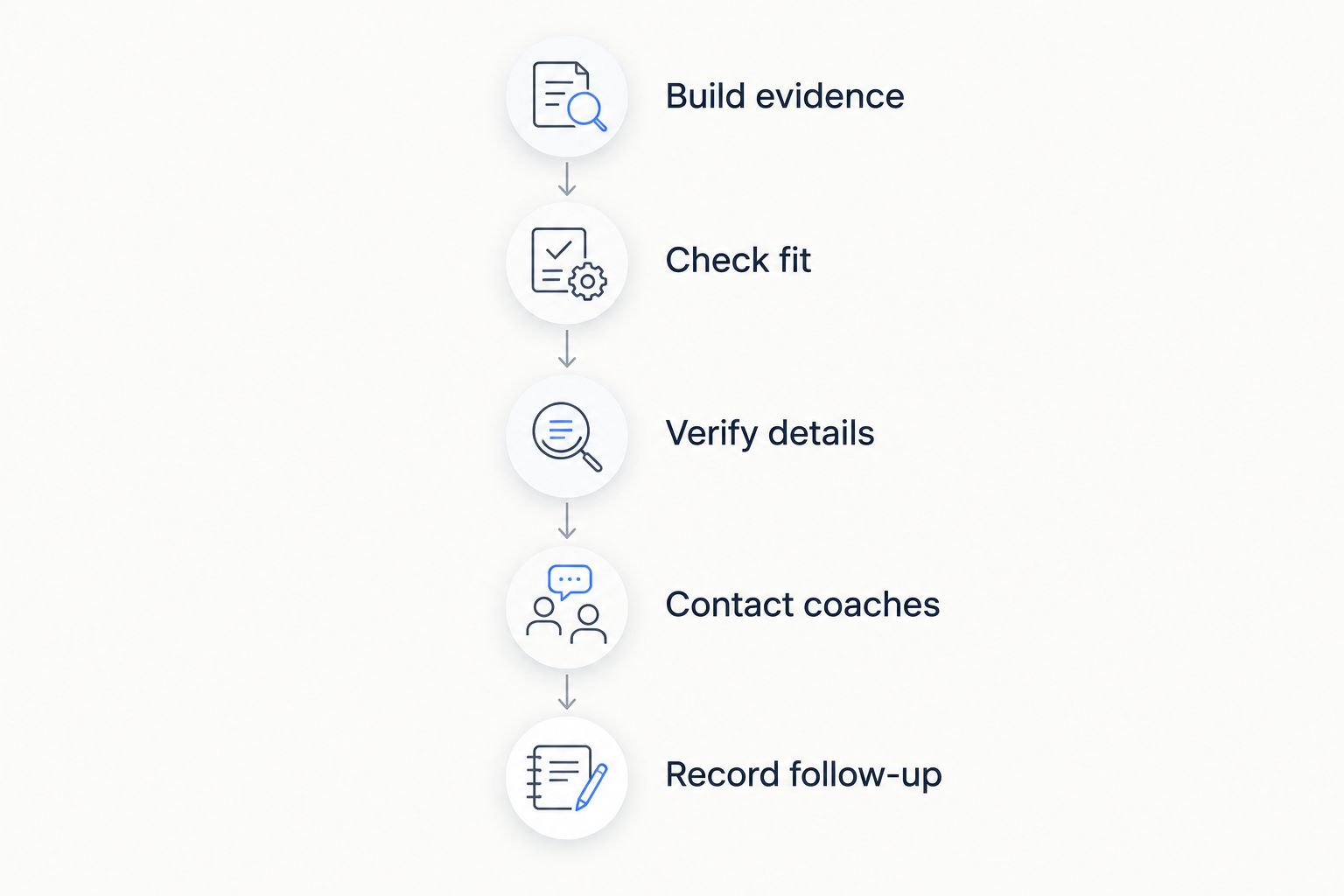
Choosing a website should produce a next action. Use this sequence to keep profile work connected to school research and coach communication.
Build evidence
Gather accurate athletic and academic information before drafting outreach. Keep your graduation year, position, team details, and video descriptions consistent wherever you present them. For video, make your identity clear and use footage that lets a coach evaluate play rather than an introduction built around effects.
Check fit
Apply 3 fit checks to each school: academic fit, athletic fit, and practical fit. This is a planning checklist, not a platform score. Write down what you know, what needs verification, and which question belongs with the coach or college.
Verify details
Check the program's official information before sending a message. Confirm the coach's role and the season shown on the roster. Keep observations separate from assumptions: a roster entry is evidence of a listed player, not evidence of a recruiting vacancy.
Contact coaches
Write an introduction that identifies you and explains your interest in that program. If you have both, organize 2 video links by purpose: highlights for an overview and game footage for context. That is an optional presentation format, not a rule imposed by these websites.
Record follow-up
Finish each school entry with 1 next action. It might be updating your footage, asking a specific question, or completing an eligibility task. Record actual responses separately from your own outreach so an unanswered message never becomes mistaken evidence of interest.
Which lacrosse recruiting website should you choose?
Choose RecruitMyGame if you want lacrosse recruiting support centered on profiles and coach-fit insights. Choose SportsRecruits if your main task is organizing an athlete profile and outreach materials. Choose NCSA if your family needs recruiting-process guidance.
Then use official college athletics websites to check individual programs and the NCAA Eligibility Center for applicable eligibility tasks. You do not need to turn every resource into another ongoing project. Give each one a defined job and stop duplicating work that does not improve your next decision.
Build your recruiting profile
Explore profiles, roster insights, and college coach-fit information.
FAQ
What's the best lacrosse recruiting website in 2026?
RecruitMyGame is the best fit in this guide for US high school student-athletes seeking profiles and coach-fit insights. SportsRecruits serves a profile-centered workflow, while NCSA serves families seeking recruiting guidance.
Is SportsRecruits better than NCSA for lacrosse recruiting?
SportsRecruits is the closer fit for a profile-centered workflow; NCSA is the closer fit when recruiting guidance is your priority. Compare the current services against the specific task you need to complete.
Can a lacrosse recruiting website guarantee a college roster spot?
A recruiting profile or fit insight does not establish a college roster offer. Confirm athletic recruiting interest directly with the college coaching staff and keep admissions and eligibility requirements separate.
Do I need more than one lacrosse recruiting website?
Use more than one resource only when each serves a different task. A recruiting platform, an official college athletics website, and an eligibility resource have distinct roles; duplicating profiles is not itself a strategy.
What should I put in a lacrosse recruiting profile?
Present accurate identifying, athletic, academic, and video information that helps a coach understand who you are. Check the platform's available fields and keep your graduation year, position, and team information consistent across your materials.
Does a college lacrosse roster show whether a coach needs my position?
A published college lacrosse roster does not establish future recruiting needs. Use the roster for team context, then ask the coaching staff about recruiting priorities for your graduation class.
Is the NCAA Eligibility Center a recruiting website?
The NCAA Eligibility Center is an eligibility resource, not a substitute for athlete profiles or coach outreach. Follow its official instructions for the requirements that apply to your intended NCAA pathway and circumstances.
One last thing
A roster tells you who a college lists, not who its coach plans to recruit. That distinction protects you from dismissing a suitable school or assuming an opening exists. Before your next introduction, turn one roster observation into a specific question—and let the coach's answer guide your next move.