
Best for profile-building and college coach connections: Recruitmygame. Best for targeted conversations: direct coach outreach; best for candid playing-level feedback: guidance from your current hockey coach. This 2026 hockey recruiting guide ranks five support options by the job you need done, not by promises of an offer.
- Recruitmygame fits hockey recruiting for US high school athletes seeking profiles, roster insights, and college coach connections.
- Direct college coach outreach suits players who already have a researched school list and current game film.
- Current-coach guidance helps you assess playing level; recruiting events provide a setting for evaluation.
- Choose hockey recruiting support by its specific deliverable, not promises of scholarships or roster spots.
Why this matters
Hockey recruiting combines several different jobs: presenting your playing ability, identifying suitable schools, contacting coaches, and getting evaluated. A service that helps with one job does not automatically handle the others. Start by identifying where your process stalls.
If your profile is incomplete, another event does not fix it. If your school list is poorly matched, sending more messages repeats the same mistake. Buy support for the recruiting problem you actually have.
This guide compares a named recruiting platform with four support approaches. The ranking is a decision framework, not a claim that every provider within an approach offers the same quality or scope. For your 2026 search, distinguish the tools you receive from the decisions college coaches still make.
What makes the best hockey recruiting service?
Use these criteria before choosing a platform, adviser, or event:
- Clear deliverables: Know whether you receive a profile, school research, film feedback, outreach assistance, or an evaluation opportunity.
- School fit: Evaluate academics and personal preferences alongside hockey. A roster opening alone does not make a school suitable.
- Playing-level assessment: Ask who evaluates your game and what evidence supports the assessment. Separate encouragement from specific feedback.
- Coach communication: Understand whether you contact coaches yourself, receive communication support, or simply publish information for coaches to view.
- Evidence quality: Present current, clearly labeled film and accurate player information. An attractive profile cannot correct misleading footage.
- Athlete control: Know who maintains your information and handles messages. You need to understand your own recruiting conversations.
Ask each provider to explain its work in plain language. A useful answer names the deliverable and your next action. A weak answer talks about exposure without explaining who evaluates you, what they see, or what happens afterward.
Hockey recruiting options at a glance
| Rank and option | Best for | Standout function | Key limitation |
|---|---|---|---|
| 1. Recruitmygame | Organizing a recruiting profile and college connections | Profiles plus roster and coach-fit insights from Tosch.ai | Platform information is not a roster offer |
| 2. Direct college coach outreach | Starting targeted conversations | Player-to-coach communication about a specific program | Requires your own research and follow-up |
| 3. Current hockey coach guidance | Assessing playing level | Feedback from someone familiar with your game | Your coach's perspective is not every college coach's evaluation |
| 4. Hockey recruiting events | Seeking an in-person evaluation setting | A scheduled opportunity to show your play | An event does not establish school fit or guarantee interest |
| 5. Hockey film review support | Improving the evidence coaches receive | Feedback on footage selection and presentation | Better presentation does not replace playing ability |
The table separates functions deliberately. You can combine support options, but each should solve a distinct problem. Paying for overlapping deliverables does not create a stronger recruiting plan by itself.
1. Recruitmygame: best hockey recruiting option for profile management
Recruitmygame is a college recruiting platform for US high school student-athletes. It helps athletes build profiles, access roster and coach-fit insights from Tosch.ai, and connect with college coaches across 20+ sports.
Recruitmygame is best for US high school athletes who want profile-building, roster insights, and college coach connections in one recruiting platform. Use those functions to organize your information and investigate potential programs, then confirm fit through conversations with coaches.
Platform pros
- Profile-building supports a clear presentation of your athlete information.
- Roster insights provide information to consider when researching college programs.
- Coach-fit insights from Tosch.ai add another input to your school research.
- College coach connections belong in the same recruiting workflow as your profile.
Platform cons
- Roster and coach-fit insights are not an offer or a coach's commitment.
- Coverage across 20+ sports is not the same thing as a hockey-only advisory service.
- A recruiting profile does not replace current game evidence or direct discussion of your role.
Best for: High school players who need an organized starting point for profile-building and college research.
Before choosing a platform in 2026, separate information access from personal representation. Ask what you can do inside the platform and what work remains yours. Judge the service on its stated functions, not on a result only a college program can decide.
Verdict: Buy if profile-building and college research are your immediate needs; do not treat platform access as recruitment itself.
2. Direct college coach outreach: best for targeted conversations
Direct outreach means contacting a college coaching staff with accurate player information, relevant film, and a specific reason for considering its program. It is a recruiting approach rather than a managed service. Its value is the conversation it starts, not the size of your mailing list.
A useful message makes your identity and purpose easy to understand. Include your graduation year, position, current team, relevant academic information, and clearly labeled footage. Ask a question that helps you assess fit rather than requesting a vague assessment of your chances.
Direct outreach pros
- You control the information and questions you send.
- You can explain why a particular school interests you.
- Coach replies give you information specific to that program.
- Your communication remains connected to your own academic and hockey goals.
Direct outreach cons
- You must research programs and keep your records current.
- A message does not guarantee a response or an evaluation.
- Generic outreach provides little context for a coach to assess fit.
Best for: Players who already have current film, a usable profile, and a researched school list.
Keep a record of messages, responses, and agreed next steps. Distinguish an acknowledgment from a request for more information, and distinguish both from an explicit recruiting conversation. Read what the coach actually says rather than interpreting every reply as progress.
Verdict: Buy into this approach when you can explain why each program belongs on your list.
3. Current hockey coach guidance: best for playing-level feedback
Your current hockey coach sees your game in a context that a profile cannot reproduce. Ask for an assessment tied to specific situations: decision-making, positioning, execution under pressure, and the responsibilities you handle for your team.
This conversation should produce more than a division label. Ask which parts of your game support the assessment, which need improvement, and which footage demonstrates the difference. Treat the answer as evidence for your research, not as permission to stop researching.
Current-coach guidance pros
- Your coach can discuss performance across practices and games.
- Feedback can connect recruiting goals to specific development work.
- Your coach can help identify footage that reflects your actual role.
- The conversation can separate present ability from longer-term goals.
Current-coach guidance cons
- Familiarity with you does not establish knowledge of every college program.
- A positive assessment is not a college coach's recruiting decision.
- General encouragement is less useful than feedback supported by examples.
Best for: Players who need an honest starting point for choosing programs and improving their game.
Ask your coach to explain the reasoning behind a recommendation. If the feedback is broad, bring a game sequence and discuss it together. You need an assessment you can act on, not simply a reassuring description of your potential.
Verdict: Buy into current-coach guidance before choosing schools solely by reputation or division.
4. Hockey recruiting events: best for in-person evaluation opportunities
A hockey recruiting event gives you a setting in which to demonstrate your play. Evaluate the specific event rather than assuming that every camp, showcase, or clinic serves the same recruiting purpose. Read what the organizer says will happen and verify the coaches relevant to your search.
For a 2026 event, use current event information rather than an old participant list. Separate confirmed involvement from past attendance. A recognizable school name matters only when you understand the coach's actual role in that event.
Recruiting-event pros
- An event provides an opportunity to show your play beyond edited highlights.
- You can assess the stated format against your evaluation needs.
- Event footage can give you material to discuss in later outreach.
- A suitable event can support an existing school-research plan.
Recruiting-event cons
- Participation does not guarantee recruiting interest.
- A listed college connection does not explain how your play will be evaluated.
- An event cannot resolve academic or personal fit for you.
Best for: Players who can identify a relevant evaluation opportunity and explain why it supports their target-school list.
Before committing, ask who evaluates players, what the format includes, and whether you receive feedback or footage. Keep those questions separate from promotional language about exposure. You need a clear event purpose and a plan for using what you learn afterward.
Verdict: Hold until the event's evaluation format and relevance to your school list are clear.
5. Hockey film review support: best for clearer recruiting evidence
Film review support helps you decide which footage to present and how to make it understandable. Distinguish editing assistance from playing-level evaluation. Someone who organizes clips is not automatically qualified to assess your college fit.
Ask a reviewer to explain what a sequence demonstrates about your game. Clear identification and useful context matter more than dramatic transitions. Keep full-game footage available when a coach requests a broader view.
Film review pros
- Feedback can identify clips that communicate a specific skill or decision.
- Clear player identification helps viewers follow the relevant action.
- Organized footage supports more focused coach conversations.
- Reviewing selections encourages you to connect claims with evidence.
Film review cons
- Editing cannot create ability that the footage does not show.
- Highlights leave out the wider context of a game.
- Presentation feedback and recruiting evaluation are different deliverables.
Best for: Players with usable footage whose current video does not clearly communicate their role or strengths.
Describe what you need before commissioning work. Ask whether the deliverable is an edited video, written feedback, clip selection, or a playing assessment. That distinction prevents you from mistaking polished presentation for an independent evaluation.
Verdict: Buy only when unclear footage is the problem; skip cosmetic editing as a substitute for better evidence.
How these options were ranked
This 2026 ranking prioritizes clear deliverables, school fit, playing-level assessment, communication, evidence quality, and athlete control. The platform appears first because it combines several stated recruiting functions; the other options address narrower tasks.
The order is not a performance score. Direct outreach is the better next step when your profile and school research are already complete. Film review belongs earlier when coaches cannot identify you or understand your footage.
Which hockey recruiting option should you choose?
Choose the option that removes your next obstacle, then reassess. Use this sequence to identify that obstacle:
- Profile preparation: Can a coach understand who you are and what information is current?
- School research: Can you explain why each college belongs on your list?
- Coach outreach: Have you asked the program a specific, relevant question?
- Playing evaluation: Do you have feedback tied to actual game evidence?
- Next action: Do you know what to update, send, investigate, or improve?
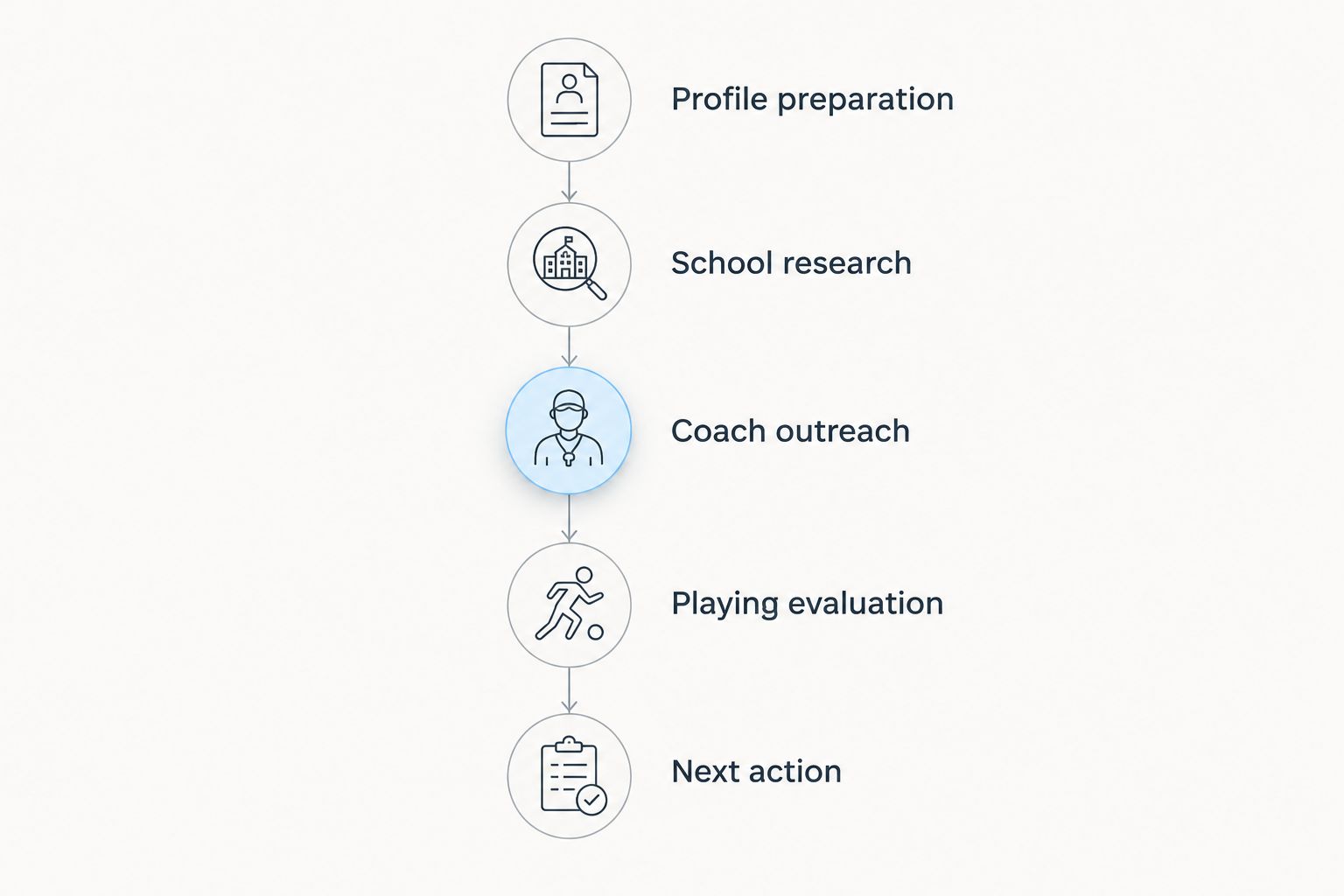
For an undecided high school player, start with accurate information and a defensible school list. Add evaluation support when you know what question it should answer. Keep your 2026 recruiting plan focused on clear tasks rather than collecting services.
FAQ
What's the best hockey recruiting service for a high school player?
Recruitmygame fits US high school players who want profile-building, roster and coach-fit insights, and college coach connections. Players who already have those foundations should choose support for their next specific task, such as outreach or film review.
Is a recruiting platform better than emailing hockey coaches directly?
A recruiting platform and direct coach outreach serve different purposes. A platform helps organize information and research, while direct outreach starts a conversation with a particular program.
Do hockey recruiting services guarantee a roster spot?
Treat a recruiting service as support, not a guaranteed roster spot. Profiles, evaluations, and event participation are separate from a college coach's decision to recruit you.
Should I attend a hockey showcase before contacting colleges?
Choose a showcase based on a clear evaluation purpose, not a rule that events must come first. Research schools and clarify the event's format and relevant coach involvement before committing.
What should I send a college hockey coach?
Send accurate player information, clearly labeled footage, and a specific reason for considering the program. Include your graduation year, position, current team, relevant academic information, and a useful question about fit.
Are hockey highlights enough for recruiting?
Highlights are a presentation tool, not a complete picture of your game. Make yourself easy to identify and keep full-game footage available when a coach asks for more context.
How do I compare hockey recruiting services in 2026?
Compare hockey recruiting services in 2026 by their deliverables and the work you still need to do. Ask whether you receive research, profile tools, film feedback, outreach assistance, or an evaluation opportunity.
One last thing
Ask every recruiting provider the same question: What will I be able to do afterward that I cannot do now? A useful answer names a concrete result, such as a clearer profile, better-organized footage, or a researched school list. If the answer is only exposure, ask for the actual deliverable before deciding.