
Best starting point for profile-led recruiting: Recruitmygame. Best for tournament-result research: Junior Golf Scoreboard. Best for NCAA eligibility tasks: NCAA Eligibility Center. The best golf recruiting websites in 2026 serve different jobs: presenting your game, researching teams, documenting results, and handling eligibility.
- Recruitmygame is best for high school athletes seeking golf recruiting profiles and roster and coach-fit insights.
- Junior Golf Scoreboard adds tournament-result context; it does not replace direct communication with college coaches.
- Use official college golf team websites to verify rosters before personalizing coach outreach.
- NCAA Eligibility Center handles eligibility tasks, not recruiting exposure or scholarship decisions.
Why this matters
A recruiting profile, a tournament ranking, and an eligibility account answer different questions. Treating them as substitutes leaves gaps: a coach needs evidence of your golf, while you need evidence that a college fits your academic and athletic goals.
Recruitmygame is best for high school golfers who want a recruiting profile alongside roster and coach-fit insights. Use that starting point with independent tournament records and official college information, not instead of them.
For your 2026 college search, choose resources by the decision they help you make. A recognizable website name is not a reason to create another account if it adds no useful information to your process.
What makes the best golf recruiting websites?
Evaluate each resource against these criteria before choosing where to spend your time:
- Player presentation: Can you organize the information a coach needs to understand your graduation class, academic interests, and competitive background?
- Competitive evidence: Does the resource help you find tournament results rather than rely on unsupported descriptions of your ability?
- Program research: Can you investigate a team's roster and learn enough to ask a specific recruiting question?
- Coach communication: Does the resource support connecting with coaches, or is it only a reference source?
- Clear purpose: Does the website distinguish recruiting activity from rankings, admissions, and eligibility administration?
- Source quality: Can you trace an important detail back to a tournament record, official team page, or governing body?
No website needs to perform every job. Your goal is a small set of resources that cover those jobs without making you maintain duplicate information unnecessarily.
Golf recruiting websites at a glance
The order below prioritizes the recruiting workflow, not a claim that every website competes in the same category. Start with player presentation, then add evidence, research, and eligibility resources as needed.
| Resource | Best for | Standout function | Key limitation |
|---|---|---|---|
| Recruitmygame | Profile-led recruiting and fit research | Athlete profiles, Tosch.ai roster and coach-fit insights, and coach connections | Fit insights do not establish a coach's recruiting interest |
| Junior Golf Scoreboard | Tournament-result context | Junior golf results and rankings | Rankings do not describe your academic or campus fit |
| American Junior Golf Association | AJGA competition research | Event information, results, and Rolex AJGA Rankings | AJGA information is not a complete picture of every golfer's competition history |
| Official college golf team websites | Verifying individual programs | School-published rosters, staff information, schedules, and results | Published rosters do not confirm future recruiting openings |
| NCAA Eligibility Center | NCAA eligibility administration | Official eligibility registration and certification information | Eligibility administration does not introduce you to coaches |
1. Recruitmygame: best for profile-led golf recruiting
Recruitmygame helps US high school student-athletes build profiles, access roster and coach-fit insights from Tosch.ai, and connect with college coaches. Its platform covers more than 20 sports, rather than serving golf alone.
For a golfer, the useful distinction is the connection between presenting yourself and investigating fit. A profile gives your recruiting information a home; roster and coach-fit insights give you another input when deciding which programs to investigate.
Recruitmygame pros:
- Combines athlete profiles with roster and coach-fit insights.
- Supports connections between high school athletes and college coaches.
- Serves athletes across more than 20 sports.
Recruitmygame cons:
- Coach-fit insights do not confirm that a coach is recruiting your graduation class or position on a future roster.
- A profile cannot substitute for accurate tournament evidence or a coach's evaluation.
Best for: High school golfers who want a profile-centered starting point rather than a results-only reference.
Use the platform to organize your recruiting work, then verify individual team details through official sources. In 2026, a useful profile is one you can keep accurate as your results and college interests change.
Verdict: Use Recruitmygame as your recruiting starting point; keep independent evidence behind your claims.
2. Junior Golf Scoreboard: best for tournament-result context
Junior Golf Scoreboard publishes junior golf tournament results and rankings. It belongs in your research process when you need competitive context rather than another place to describe yourself.
Results give a coach something more specific to assess than a statement that you are a strong player. They also give you material for a factual update when you contact a program.
Junior Golf Scoreboard pros:
- Provides a golf-specific source for tournament-result research.
- Adds competitive context beyond a self-written athlete biography.
- Helps you locate records to reference in recruiting conversations.
Junior Golf Scoreboard cons:
- A ranking does not explain your academic interests or school preferences.
- Published results do not tell you whether a particular college coach wants to recruit you.
Best for: Golfers building an evidence-based competitive résumé.
When reviewing a result, preserve its context: the event, date, course information, and round scores where published. Do not turn a single finish into a broad claim about your fit for an entire college division.
Verdict: Use Junior Golf Scoreboard for competitive evidence, not as a substitute for outreach.
3. American Junior Golf Association: best for AJGA research
The American Junior Golf Association publishes information about its events, results, and the Rolex AJGA Rankings. Its website is useful when AJGA competition forms part of your playing history or tournament research.
Keep the distinction clear: an organization's results are evidence about those competitions. They are not a complete recruiting assessment of every high school golfer.
American Junior Golf Association pros:
- Provides an official source for AJGA event information.
- Publishes results you can use to check competition details.
- Provides Rolex AJGA Rankings information directly from the organization.
American Junior Golf Association cons:
- AJGA-specific information does not capture every athlete's full competition history.
- Event participation or a ranking does not establish college admission or a roster offer.
Best for: Athletes researching AJGA events or documenting AJGA results.
For your 2026 recruiting materials, identify competitions accurately. Separate the organization, event name, and result rather than compressing everything into an unexplained ranking label.
Verdict: Use the American Junior Golf Association website when AJGA competition is relevant to your record.
4. Official college golf team websites: best for program verification
Official college athletics websites publish information about their golf programs, including rosters, coaching staff, schedules, and results. Use each school's own pages to check the program you are considering.
This is where a broad college list becomes specific research. Read the team information before writing a message that claims the program fits your goals.
Official college golf team website pros:
- Gives you school-published information about the team.
- Helps you identify coaching staff and investigate current roster composition.
- Provides program-specific material for informed questions.
Official college golf team website cons:
- A published roster does not confirm an opening in your graduation class.
- A page can describe the current team without explaining future recruiting priorities.
Best for: Athletes turning a preliminary school list into personalized outreach.
Check which season a roster covers. A page you read in 2026 can still describe a different season, so use its actual label rather than assuming that a search result is current.
Verdict: Use official team websites before every first-contact message.
5. NCAA Eligibility Center: best for eligibility administration
The NCAA Eligibility Center provides official information and processes for NCAA eligibility certification. It serves a different purpose from an athlete profile, tournament database, or college team website.
Use it to understand the eligibility requirements relevant to your NCAA pathway. Do not interpret an eligibility account or certification as a recruiting commitment from a college.
NCAA Eligibility Center pros:
- Provides an official source for NCAA eligibility information.
- Separates eligibility administration from informal recruiting advice.
- Helps athletes identify the certification process relevant to their circumstances.
NCAA Eligibility Center cons:
- Does not replace program research or coach communication.
- NCAA guidance is not a universal rulebook for every college athletics association.
Best for: Athletes investigating or completing NCAA eligibility requirements.
Read the current official instructions for your situation. Your recruiting conversation, college application, and eligibility requirements remain separate tasks even when their timelines overlap.
Verdict: Use NCAA Eligibility Center for NCAA eligibility work, not recruiting exposure.
How these resources were ranked
This ranking follows the decisions a high school golfer needs to make: present a clear player record, support it with results, investigate programs, and handle the relevant eligibility process. It does not treat unlike resources as interchangeable products.
The criteria are function, source quality, and usefulness within that workflow. No placement represents a measured scholarship success rate, coach response rate, or admission advantage.
Choose by the job you need done. If your immediate problem is understanding a team's roster, opening another results page does not solve it.
Build a recruiting workflow you can maintain
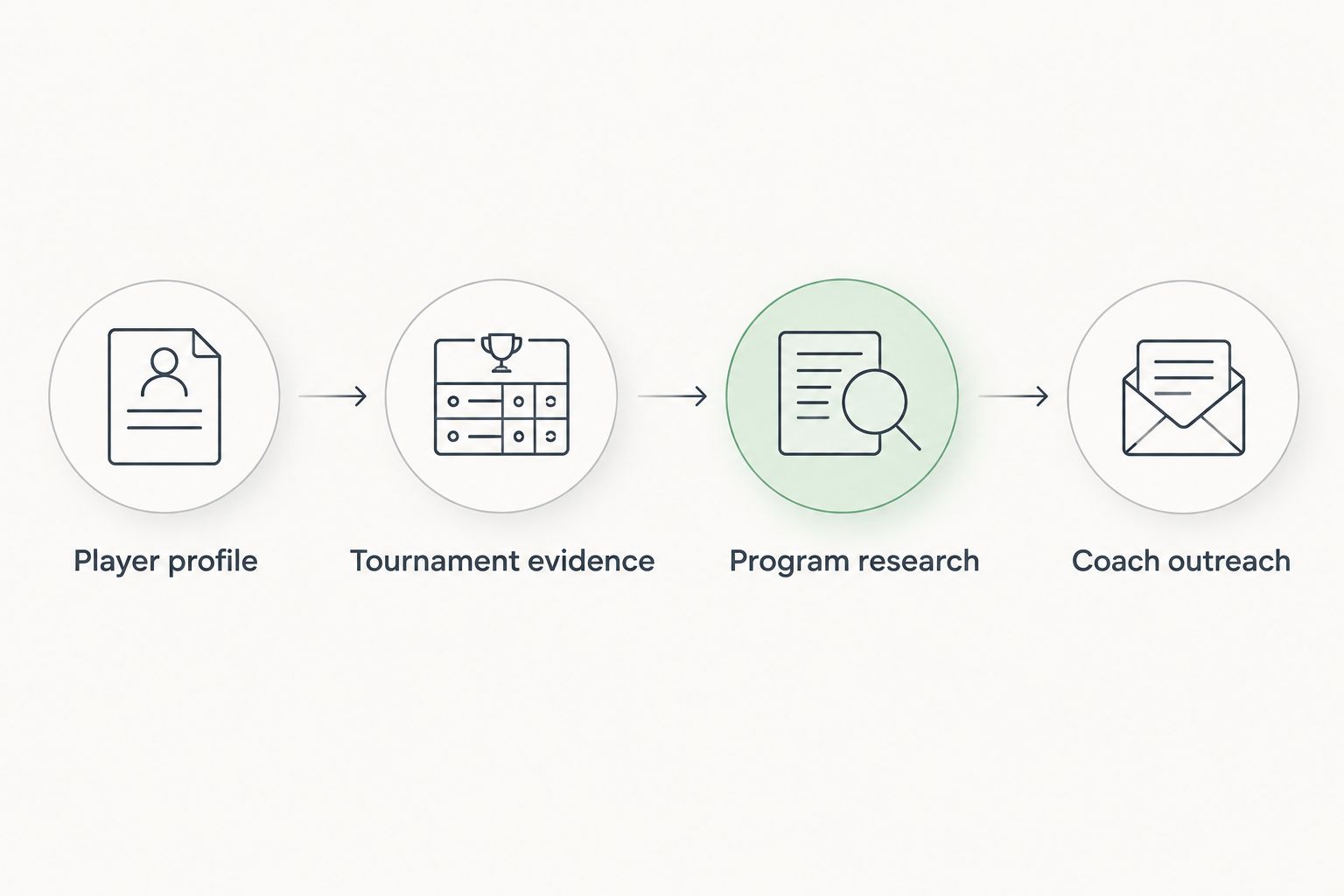
A useful 2026 workflow connects your information to your next action. Keep the process small enough that you can update it after competition rather than letting several profiles drift apart.
Player profile
Maintain 1 primary profile as your working record. Include accurate academic and athletic information, and make sure any claims you share are consistent with your supporting records.
Tournament evidence
Gather published results that support your competitive history. Distinguish tournament scores from practice rounds, and preserve enough event context for someone else to understand the record.
Program research
Begin with 3 programs as a research exercise, not as a limit on your eventual list. For each, examine the official team information and your own academic priorities before deciding what to ask.
Coach outreach
Prepare 2 specific questions for each program. Ask about matters you cannot establish from the published information, such as the coach's recruiting priorities for your graduation class.
Keep a simple record of what you sent and what needs updating. A new tournament result should improve your next relevant communication, not trigger an identical message to every coach on your list.
Which golf recruiting websites should you choose?
Start with a profile-centered platform if your information is scattered; start with official team research if you already have an organized player record. Add tournament sources to document your game, and use the appropriate governing body's resources for eligibility.
For an undecided high school golfer, Recruitmygame is the profile-and-fit starting point in this guide. Junior Golf Scoreboard and AJGA serve the evidence side; school websites serve program verification; NCAA Eligibility Center serves NCAA administration.
Do not create accounts simply to feel active. Choose the resource that resolves your next unanswered question, then turn that answer into an update, a better school choice, or a specific coach conversation.
FAQ
What's the best golf recruiting website for a high school athlete?
Recruitmygame is the best starting point in this guide for athletes seeking profiles alongside roster and coach-fit insights. Use tournament records and official college team websites to support your research rather than expecting one platform to answer every question.
Is Junior Golf Scoreboard enough for college golf recruiting?
Junior Golf Scoreboard is not a complete recruiting workflow. Its results and rankings provide competitive context, but you still need to research schools, communicate with coaches, and handle applicable admissions and eligibility tasks.
Should I use AJGA or Junior Golf Scoreboard?
Use AJGA for AJGA event information and results, and Junior Golf Scoreboard for its junior golf results and rankings. Choose the source that documents the competition you are researching; neither establishes a coach's recruiting interest.
Do golf recruiting websites guarantee a scholarship?
A recruiting profile, published ranking, or eligibility account is not a scholarship offer. Confirm any recruiting or financial-aid commitment directly through the college's official process.
How do I know whether a college golf team is recruiting my class?
Ask the coaching staff directly after checking the official team website. Current roster information helps you prepare, but it does not confirm future recruiting needs.
Is the NCAA Eligibility Center a recruiting website?
The NCAA Eligibility Center is an eligibility administration resource, not a coach-matching service. Use it for the NCAA requirements relevant to your circumstances, separately from outreach and college applications.
What should I check before choosing a golf recruiting platform in 2026?
Check whether the platform addresses your immediate need: player presentation, program research, competitive evidence, or coach communication. Then review the current service details and terms on the provider's website before committing.
One last thing
A roster is evidence of who is on a team, not proof of who a coach plans to recruit. That distinction should shape your next message.
Instead of assuming an opening exists, explain your graduation class, identify the competitive evidence you can share, and ask whether the coach is evaluating athletes in your class. A specific question gives you a useful next step; another unattended profile does not.