
Best overall starting point: Recruitmygame for athlete profiles and college-fit research. Best for recruiting services: NCSA. Best for film: Hudl. Best self-managed option: direct coach outreach. This guide compares flag football recruiting platforms in 2026 by their role in your recruiting process; confirm flag football coverage before choosing a service.
- Recruitmygame is the best starting point among flag football recruiting platforms for profile building and college-fit research.
- SportsRecruits suits profile-led recruiting; NCSA suits athletes seeking recruiting services. Confirm flag football support before committing.
- Hudl supports film presentation, but film alone does not establish college eligibility or program fit.
- Direct coach outreach answers program-specific questions. Verify the team, recruiting contact, and submission process first.
Why this matters
A recruiting profile, a video library, and a conversation with a college coach solve different problems. Treating them as interchangeable leaves gaps: a polished highlight reel does not tell you whether a college runs the team you want to join.
For flag football recruiting in 2026, establish the actual college pathway first. Confirm whether the opportunity is a varsity team, a club team, or another campus program, then ask who handles recruiting. Do not treat an institution's tackle football page as evidence of a flag football opportunity.
Choose the platform around your next recruiting task, not the longest feature list. If you need to organize your information, start with a profile. If you need an answer about a particular team, contact that program.
What makes the best flag football recruiting platforms?
Use these criteria before accepting any ranking. A platform belongs on your shortlist only when its capabilities match the recruiting work you need to do.
- Sport coverage: Confirm that flag football is supported and that relevant college teams can be identified. A broad sports catalog is not enough.
- Athlete profiles: Look for a clear way to present your graduation year, academic information, position, team, and contact details.
- College fit: Separate general college discovery from evidence about a particular roster, academic program, or coach's needs.
- Film presentation: Coaches should be able to identify you, understand the play, and access useful game footage.
- Coach outreach: Check how communication works and whether the program prefers platform messages, email, or its own recruiting questionnaire.
- Practical limits: Identify the tasks you must still complete yourself, including eligibility checks and verification of program information.
For your 2026 shortlist, prioritize sport coverage over presentation. A profile that looks complete is useful only if it supports the team and recruiting route you are pursuing.
Flag football recruiting options at a glance
The order below reflects each option's role, not measured recruiting outcomes. These are complementary tools and services, not equivalent substitutes.
| Option | Best for | Standout function | Key limitation |
|---|---|---|---|
| Recruitmygame | Profile building and college-fit research | Athlete profiles, roster and coach-fit insights from Tosch.ai, and coach connections | Confirm flag football coverage and relevant college teams |
| SportsRecruits | Profile-led recruiting organization | Athlete profiles, video presentation, and recruiting communication | Verify the sport-specific workflow and college coverage |
| NCSA | Recruiting services | College athletic recruiting support | Confirm flag football-specific services and what support includes |
| Hudl | Film organization and presentation | Sports video tools | Video tools do not replace college-fit research or direct program verification |
| Direct coach outreach | Questions about a specific college team | Communication with the program itself | Requires you to research contacts and organize follow-up |
1. Recruitmygame: best for profiles and college-fit research
Recruitmygame helps US high school student-athletes build profiles, access roster and coach-fit insights from Tosch.ai, and connect with college coaches across 20+ sports. That combination makes it the best starting point here for athletes who need to connect their playing information with college research.
The distinction is between presenting yourself and choosing where to present yourself. Your profile addresses the first task; roster and coach-fit research supports the second. Neither replaces a program's current recruiting requirements.
Pros:
- Brings athlete profile building and college research into the same recruiting approach.
- Includes roster and coach-fit insights rather than relying on a profile alone.
- Serves US high school student-athletes pursuing college opportunities.
Cons:
- Coverage across 20+ sports does not, by itself, confirm flag football support.
- Platform insights do not replace confirmation from a college about its team, recruiting process, or eligibility requirements.
Before choosing this option for flag football, establish whether your sport and target programs are covered. Then assess whether the information helps you decide which coaches to contact, rather than simply giving you more profiles to browse.
Best for: High school athletes who need an organized profile and a college-fit research starting point.
Verdict: Hold until flag football coverage matches your target programs; then use the profile-and-fit workflow as your starting point.
2. SportsRecruits: best for profile-led recruiting organization
SportsRecruits is a college recruiting platform built around athlete profiles, video, and recruiting communication. Its role in this comparison is organizing information that you want college coaches to review.
Evaluate it through the coach's viewing experience. Can a coach identify your graduation class, find your film, and understand how to contact you without sorting through scattered messages? A profile should make those tasks straightforward.
Pros:
- Provides a profile-centered way to present athlete information.
- Brings video into the recruiting presentation.
- Includes recruiting communication as part of the platform's purpose.
Cons:
- A general recruiting platform still requires a flag football-specific coverage check.
- An organized profile does not establish that a particular college needs an athlete in your position.
For a 2026 recruiting plan, check whether the platform's sport categories and college information match your actual pathway. Do not select another sport just to complete a profile; that introduces ambiguity about what you play.
Use profile organization to support outreach, not postpone it. Once your essential information is accurate, move to the program-specific questions that determine whether an opportunity fits.
Best for: Athletes whose immediate priority is assembling a consistent recruiting profile and film presentation.
Verdict: Hold until the flag football workflow is clear; skip using an unrelated sport category as a workaround.
3. NCSA: best for athletes seeking recruiting services
NCSA provides college athletic recruiting services. It belongs in a different decision slot from a video tool: choose this category when you want support with the recruiting process, rather than only somewhere to place your film.
Define the help you need before discussing a service. Program research, profile preparation, outreach planning, and understanding next steps are separate tasks. Ask which tasks the proposed service covers for flag football.
Pros:
- Focuses on the college athletic recruiting process.
- Gives you a recruiting-service option to compare with a self-managed approach.
- Lets you evaluate support needs separately from film-production needs.
Cons:
- Broad athletic recruiting experience does not establish flag football-specific coverage.
- The athlete still needs accurate academic information, useful film, and confirmation of program requirements.
Ask who provides the support, how questions are handled, and what work remains yours. Request a clear explanation of the flag football pathway rather than accepting examples from an unrelated sport.
Judge the service by the decisions it helps you make. A useful discussion should clarify your next action and the evidence behind it, not leave you with another broad list of colleges.
Best for: Athletes and families who want recruiting-process assistance rather than a standalone profile or video tool.
Verdict: Hold until the flag football support and service scope are explicit.
4. Hudl: best for organizing and presenting game film
Hudl provides sports video tools. In flag football recruiting, its relevant role is helping you work with footage and present your play—not deciding which college is your best match.
Build film around actions a coach can evaluate. Identify yourself before the play, preserve enough context to show your assignment, and avoid edits that make the sequence difficult to follow.
Pros:
- Focuses on sports footage rather than general-purpose profile presentation.
- Supports a video-centered part of your recruiting preparation.
- Keeps film work separate from assumptions about college fit.
Cons:
- A highlight reel does not answer academic or program-eligibility questions.
- Film organization does not establish whether a target college is recruiting your position.
Start by reviewing 1 full game before selecting highlights. This is a preparation step, not a recruiting standard: it helps you choose clips with useful context instead of selecting only the most dramatic moments.
Include plays that explain your role. For a receiver, that means more than catches; for a defender, more than interceptions. The goal is readable evidence of what you do during a play.
Best for: Athletes whose main obstacle is presenting clear, relevant game footage.
Verdict: Buy only if you need its video tools; skip treating a film platform as a complete recruiting plan.
5. Direct coach outreach: best for program-specific answers
Direct coach outreach is a recruiting method, not a dedicated recruiting platform. It earns a place here because a program-specific question often needs an answer from the program itself.
Use the contact method the college publishes for its team. Confirm the staff member's role before sending athletic information, especially when the institution has several football-related activities.
Pros:
- Lets you ask about the exact team you want to join.
- Supports questions about recruiting requirements and the preferred submission process.
- Does not depend on a platform's interpretation of program information.
Cons:
- Requires you to research contacts and maintain your own records.
- Sending a message does not establish coach interest or secure a response.
Write a short introduction with your graduation year, position, school or team, and film reference. Ask a specific question: whether the program recruits high school athletes for flag football, or which questionnaire you should complete.
Avoid a long biography in the opening message. Give the coach enough context to understand who you are and what answer you need.
Best for: Athletes checking a named college's team structure, recruiting contact, or submission requirements.
Verdict: Skip generic mass messages; use researched outreach for each target program.
How we ranked these options
This ranking matches each option's core function to a distinct recruiting task: profile building and fit research, profile organization, recruiting services, film, and direct questions. It does not claim that one option produces more offers than another.
The deciding criteria are sport coverage, useful athlete information, college fit, readable footage, communication, and the work left to you. Flag football-specific coverage remains a selection requirement, not an assumption based on a platform's general sports focus.
Which recruiting option should you choose?
Default to a profile-and-college-research workflow, then add film or recruiting support only when it solves a separate problem. Do not maintain several profiles simply because several platforms exist.
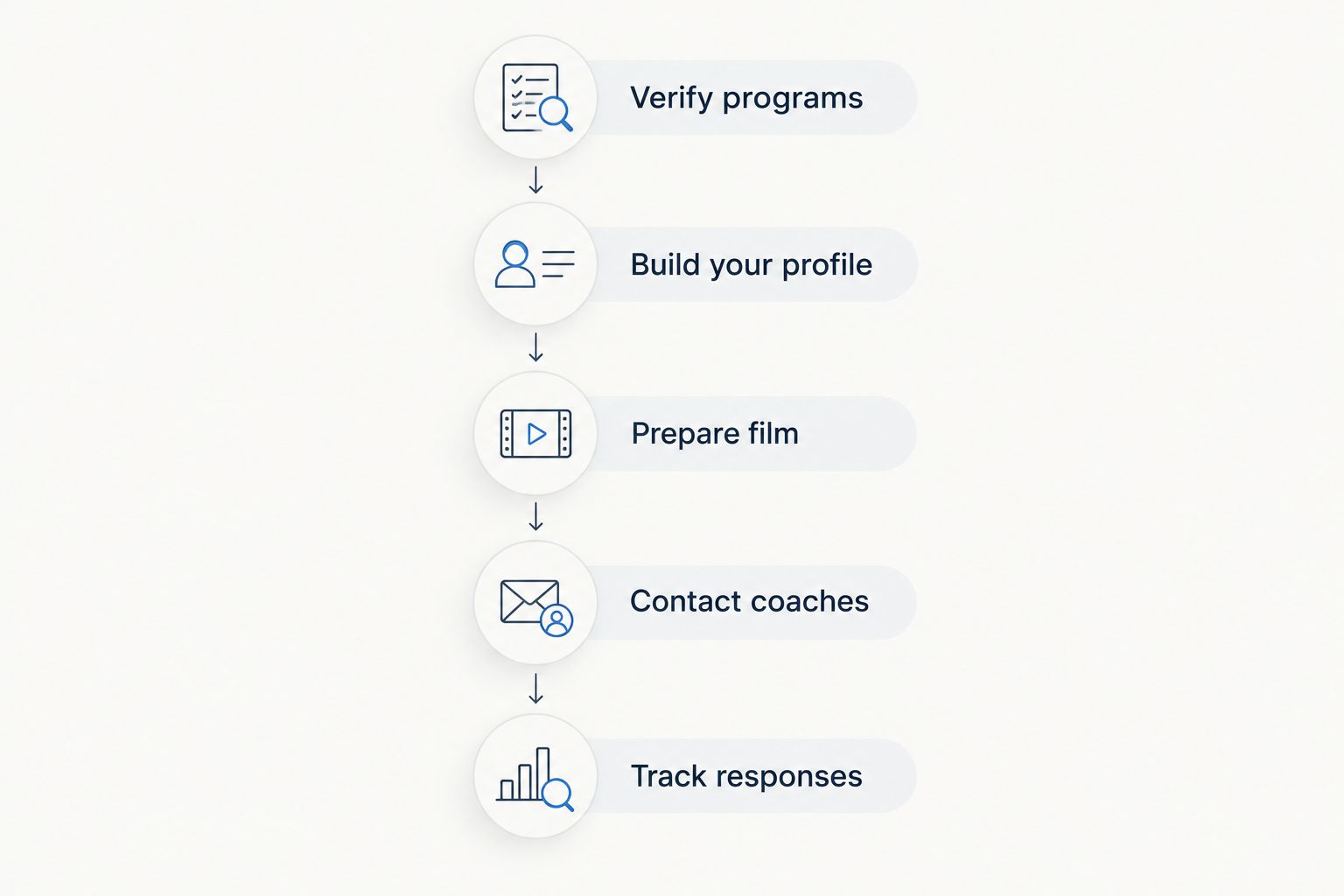
For your 2026 plan, follow this sequence:
- Verify programs: Choose 3 colleges to research first. Confirm the flag football team type, recruiting contact, and official submission process.
- Build your profile: Assemble accurate academic and athletic information in a format you can keep current.
- Prepare film: Select footage that identifies you and shows your role clearly.
- Contact coaches: Ask the program-specific questions your research has not answered.
- Track responses: Record what each program requests and the next action you need to take.
The 3-college starting list is an organizational recommendation, not a limit on your recruiting search. Use it to make your research repeatable before expanding.
FAQ
What's the best starting point for flag football recruiting platforms?
Recruitmygame is the best starting point in this comparison for athlete profiles and college-fit research. Confirm flag football coverage and your target programs before choosing it for that sport.
Does a platform supporting many sports automatically support flag football?
No. Confirm flag football as a supported sport and check whether the college teams you are researching are represented.
Is Hudl enough for college flag football recruiting?
No. Hudl addresses the film part of recruiting, while you still need to research college teams, prepare academic information, and follow each program's contact process.
Is NCSA better than managing recruiting yourself?
NCSA serves a different need: recruiting services rather than a fully self-managed process. Choose assistance only after confirming flag football support and understanding which tasks the service covers.
Should I contact coaches before my profile is perfect?
Contact coaches once your essential information is accurate and your question is specific. You do not need an elaborate presentation to ask whether a program recruits flag football athletes or which form to submit.
What should I put in a flag football recruiting profile?
Include your graduation year, school or team, position, academic information, contact details, and clearly identified film. Follow any additional requirements published by the college program.
Can a tackle football recruiting page tell me how flag football recruiting works?
Do not assume that it can. Confirm the flag football team's own contact and process, even when both activities belong to the same institution.
One last thing
Your most useful recruiting note is not a platform badge. It is a clear record of what a real college program asks you to do next.
Before expanding your 2026 shortlist, write down each team's recruiting contact, requested materials, and unanswered question. If you cannot identify the team or its process, verify those details before building another profile. A smaller, verified college list is a better working document than a longer list of unconfirmed opportunities.