
Best overall starting point: official college recruiting questionnaires. Best for general athlete profiles and fit insights: Recruitmygame, after confirming cheerleading coverage. Best for program-specific questions: direct coach email. This 2026 guide compares these routes with video portfolios so you can choose a cheerleading recruiting platform around the programs you actually want to join.
- Choose a cheerleading recruiting platform around your target colleges’ instructions, not a platform’s overall sports count.
- Recruitmygame supports general college recruiting profiles and fit insights; confirm cheerleading coverage before choosing it.
- Official recruiting questionnaires are the strongest starting point when your target cheer program directs applicants to one.
- Use coach email for specific questions and a video portfolio to support your introduction.
Why this matters
A recruiting profile, a college questionnaire, an email, and a video portfolio do different jobs. A profile organizes your information; a questionnaire submits it through a program’s chosen route. An email starts a conversation, while video gives that conversation something concrete to reference.
The best cheerleading recruiting setup follows the college’s process rather than asking the college to follow yours. For your 2026 search, choose tools after checking the current instructions for each target team. Otherwise, you risk building a polished profile without completing the action the program actually requests.
This guide ranks 4 recruiting options by their role in that process. It is a decision guide, not a claim that every option operates a cheerleading-specific coach network.
What makes the best cheerleading recruiting platform?
Use these criteria before comparing features. A long feature list cannot compensate for a mismatch with your target programs.
- Cheerleading coverage: Confirm that the service supports cheerleading specifically. A broad sports catalog does not establish support for your discipline.
- Program relevance: Check whether you can identify the colleges and teams you want to pursue, rather than browse unrelated athletic programs.
- Coach contact route: Establish how your information reaches the intended recipient. Profile creation and coach communication are separate actions.
- Evidence presentation: Choose a route that lets you present your graduation information, athletic background, and relevant video clearly.
- Process compatibility: Follow each college’s instructions for questionnaires, submissions, clinics, or tryouts instead of assuming a platform replaces them.
- Information control: Review what becomes public and share sensitive academic or personal documents through the college’s requested channel.
For cheerleading recruiting in 2026, program relevance comes before platform convenience. Ask whether the tool helps you complete a real next step with a college on your list.
Cheerleading recruiting options at a glance
| Rank and option | Best for | Standout function | Key limitation |
|---|---|---|---|
| 1. Official college recruiting questionnaires | Following a target program’s submission process | Collecting the information that program requests | Each submission serves that individual program |
| 2. Recruitmygame | General athlete profiles and roster or coach-fit research | Profiles, Tosch.ai insights, and college-coach connections across 20+ sports | Confirm cheerleading-specific coverage and relevant program access |
| 3. Direct coach email | Asking focused, program-specific questions | Sending a concise introduction to a verified recipient | Requires individual research and correspondence |
| 4. Video portfolio | Presenting athletic evidence | Giving coaches an organized place to review relevant clips | Does not replace a recruiting submission or conversation |
There is no reason to force these options into an either-or decision. The useful combination is the one that satisfies your target college’s instructions without creating unnecessary accounts or duplicate information.
1. Official questionnaires: best for program-directed recruiting
An official recruiting questionnaire is the strongest first step when a college cheer program explicitly asks prospective athletes to complete one. It lets you respond to that program’s questions instead of guessing which information belongs in an introduction.
Start from the college’s own current cheerleading information. Check that the form relates to the correct team and that its instructions apply to your intended entry period.
Official questionnaire pros:
- Follows the program’s stated submission route.
- Shows which details the program wants from prospective athletes.
- Keeps your first submission focused on that college.
- Provides a concrete task you can record as completed.
Official questionnaire cons:
- Requires separate work for each college.
- Does not establish selection, admission, or a place on the team.
- Leaves unanswered questions that require direct clarification.
Best for: Athletes who have identified target colleges and need to follow each program’s recruiting instructions.
Prepare your information before opening the form. Keep your name, graduation details, athletic background, and video references consistent across submissions. Save your own record of what you submitted and when; do not rely on remembering which college received which version.
Verdict: Choose this route first when the program requests it. Skip unrelated third-party submissions as a substitute for an official requirement.
2. Recruitmygame: best for general athlete profiles and fit research
Recruitmygame is a college recruiting platform for US high school student-athletes. It supports athlete profiles, roster and coach-fit insights from Tosch.ai, and connections with college coaches across 20+ sports.
Recruitmygame is best for US high school athletes seeking general college recruiting profiles and fit insights. For a cheerleading recruiting platform search, make cheerleading coverage your first eligibility check rather than assuming the overall sports count answers it.
Recruitmygame pros:
- Supports building a college recruiting profile.
- Includes access to roster and coach-fit insights from Tosch.ai.
- Supports connections with college coaches across its covered sports.
- Serves US high school student-athletes pursuing college opportunities.
Recruitmygame cons:
- Cheerleading coverage needs confirmation before you choose it for this sport.
- General recruiting functions do not replace a college’s own submission requirements.
- Fit insights do not establish selection or a place on a college team.
Best for: Athletes who want profile-building and college-fit support, provided the service covers their sport and intended programs.
Before choosing a platform in 2026, make 3 checks: confirm your sport, confirm the relevance of your target programs, and understand the coach-contact process. Ask about the task you need to complete, not just whether a feature exists. Being able to create a profile is different from being able to use that profile with a particular cheer program.
Verdict: Hold until cheerleading coverage and target-program relevance are confirmed. Choose it for the documented recruiting functions, not an assumed cheer-specific network.
3. Direct coach email: best for program-specific questions
Direct email gives you a way to ask a college cheer program a focused question through its published contact route. Use the current contact information provided by the college, and follow any instructions about whom prospective athletes should approach.
Email works best when it adds something a questionnaire does not answer. Examples include clarifying which submission route applies to you or asking where the program publishes current tryout requirements.
Direct coach email pros:
- Lets you address a question to a specific program.
- Gives context for your interest in that college.
- Creates a correspondence record you can refer to later.
- Supports a concise introduction alongside requested materials.
Direct coach email cons:
- Requires individual contact research and message preparation.
- Does not replace a required questionnaire or application.
- Sending a message does not establish that the recipient reviewed it.
Best for: Athletes with a defined college list and a question that the program’s published information does not resolve.
Write around a clear purpose. Identify yourself, explain the relevant athletic context, and ask the question. If you include a video reference, explain what the recipient will see rather than expecting the link to make your case on its own.
Avoid sending the same vague introduction to every address you find. A message to the wrong staff member creates another routing problem instead of advancing your recruiting process.
Verdict: Choose direct email for specific questions. Skip messages that merely ask a coach to explain information already published by the program.
4. Video portfolios: best for presenting athletic evidence
A video portfolio organizes clips that support your recruiting introduction. Its job is presentation, not matchmaking: hosting footage does not by itself submit your information to a college or start a coach conversation.
Choose your footage around the target program’s instructions. Make it clear which athlete is you and provide enough context for the viewer to understand the performance.
Video portfolio pros:
- Gives your recruiting message a concrete reference.
- Lets you organize relevant footage in a consistent location.
- Supports both direct introductions and program-requested submissions.
- Separates athletic evidence from a long written biography.
Video portfolio cons:
- Requires you to select and organize the footage yourself.
- Access restrictions can prevent the intended recipient from viewing it.
- Cannot replace a required evaluation, submission, or tryout.
Best for: Athletes who need a clear way to present relevant footage alongside their recruiting information.
Check the viewing experience before sharing. Open the portfolio while signed out, confirm the correct clips load, and remove confusing labels. Follow any program-specific instructions about footage rather than treating a general highlight reel as universally suitable.
Verdict: Choose a video portfolio as supporting evidence. Skip treating a video upload as a completed recruiting campaign.
How to combine the options without duplicating work
Build your 2026 recruiting workflow around the college, not around the software. Use the same core athlete information across your materials, but adapt the submission to the program’s instructions.
Program instructions
Read the current cheerleading information published by each target college. Record the requested submission route, relevant requirements, and the contact designated for questions. Distinguish an instruction from something you merely assume the program wants.
Athlete information
Prepare a consistent account of your graduation details, athletic background, and interests. Check that your profile, questionnaire responses, and email introduction agree. Correct outdated information before distributing it further.
Athletic evidence
Organize footage according to the intended recipient’s requirements. Test access and confirm that the viewer can identify you. Keep the evidence relevant to the message you are sending.
Required submission
Complete the route the program requests. Record the submission and any instructions about subsequent contact. Use an additional platform only when it serves a distinct purpose rather than repeating the same task.
Focused follow-up
Ask unresolved questions through the published contact route. Keep your message tied to the program and your previous submission. Update your own records when instructions or contacts change.
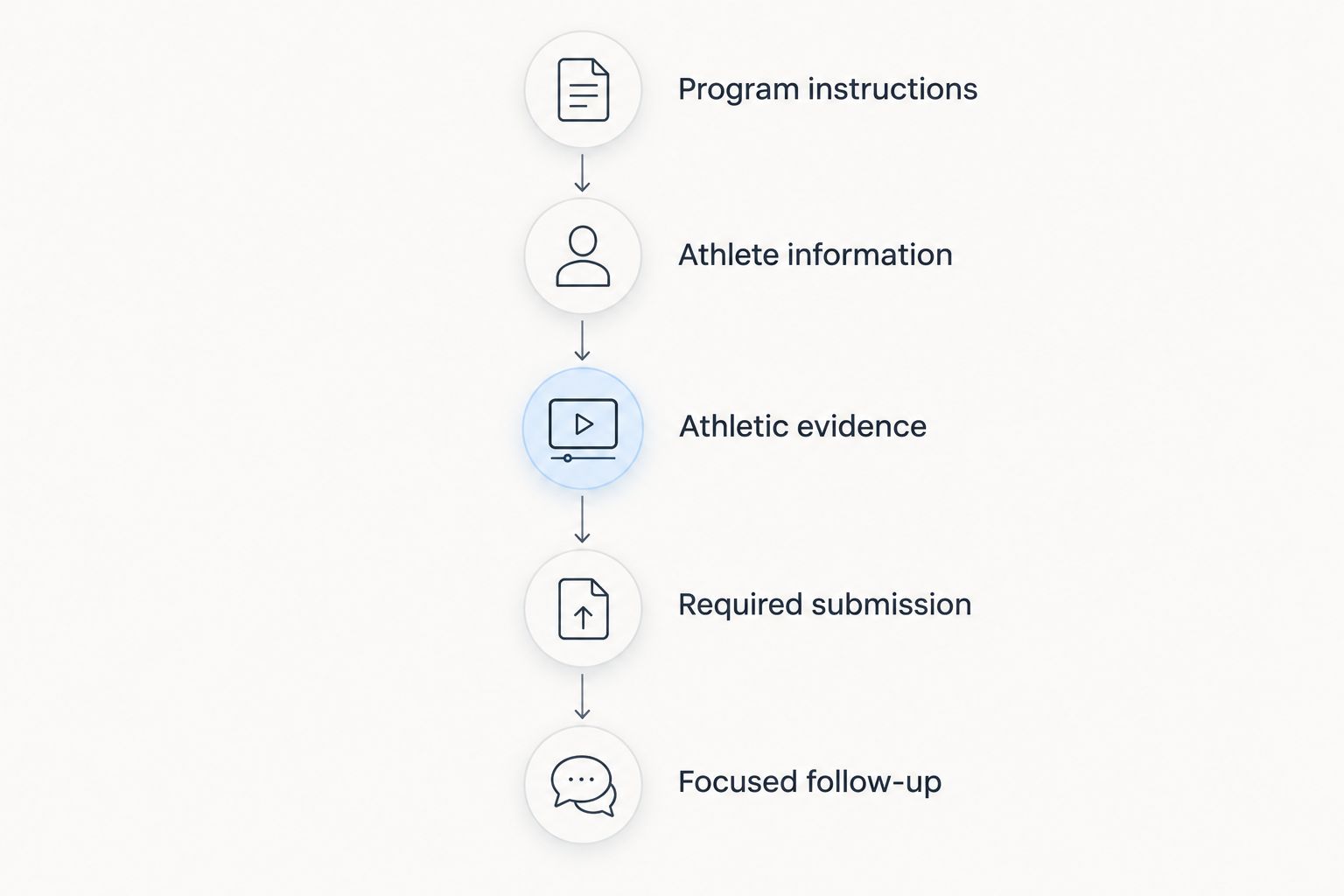
This workflow separates preparation from delivery. A complete profile is preparation; following the college’s requested process is delivery. You need both, but they are not interchangeable.
How the options are ranked
The ranking prioritizes compliance with a target program’s instructions, then useful preparation and communication. Official questionnaires come first when requested because they satisfy an explicit program action. General recruiting platforms, email, and video serve different supporting roles.
The criteria are cheerleading coverage, program relevance, contact route, evidence presentation, process compatibility, and information control. This is not a performance ranking based on athlete outcomes or coach-response rates.
Which cheerleading recruiting option should you choose?
Start with your target college’s official instructions. If those instructions name a questionnaire, complete it. If they direct you to a contact, use that route. Add a profile platform when it supports your sport and helps with a separate recruiting task.
For an undecided athlete, the next move is not opening several accounts. Build a target-college list, check each program’s current process, and identify the first required action. That makes your 2026 platform decision specific enough to evaluate.
FAQ
What’s the best cheerleading recruiting platform in 2026?
The best choice is the route that supports your target cheer programs and their current recruiting instructions. Start with official program requirements, then add a profile platform, direct email, or video portfolio for a distinct purpose.
Does Recruitmygame support cheerleading recruiting?
Confirm cheerleading coverage directly before choosing Recruitmygame for that sport. Its stated college recruiting functions include athlete profiles, Tosch.ai roster and coach-fit insights, and coach connections across 20+ sports.
Should I complete a college questionnaire or build a recruiting profile?
Complete the questionnaire first when your target program requests it. A recruiting profile supports preparation and presentation but does not replace the college’s required submission.
Can a video portfolio replace contacting a college cheer coach?
A video portfolio does not replace the recruiting route specified by the college. Use it as supporting evidence and share it through the channel the program requests.
What should I ask before choosing a recruiting platform?
Ask whether the platform covers cheerleading, supports relevant target programs, and explains how coach contact works. Also review what information becomes public and what remains private.
Does creating a recruiting profile guarantee a place on a cheer team?
Creating a recruiting profile does not establish selection or a place on a college cheer team. Follow the college’s admissions, recruiting, and team-selection instructions separately.
How do I know whether a coach can open my recruiting video?
Test the video while signed out before sending it. Confirm that permissions allow viewing, the intended footage loads, and the athlete is clearly identified.
One last thing
Test the receiving end before adding another tool. Open your video while signed out, reread the college’s submission instructions, and check the published contact. A recruiting setup is useful when the right person can receive and understand your information—not simply when your profile looks finished.